

Summary
During the preparation of a revision of the Cyrtandra terrae-guilelmi complex, endemic to Papua New Guinea, several new species were identified from material that had been misidentified as belonging to this group. Here, we formally describe two of these. Cyrtandra menyamyana S.Hatt & Bramley can be distinguished from all other Cyrtandra by its densely hairy whitish-cream to orange yellow flowers with corolla lobes in 2+3 configuration and subequal leaf pairs with the major leaf oblanceolate with a toothed-crenate margin. This species is known only from an area no greater than 82 km2. Cyrtandra wagauensis S.Hatt & Bramley is similar to C. asekiensis S.Hatt & Bramley, but can be readily distinguished by having a thick, glabrous calyx, red, infundibular flowers, and narrowly acuminate leaves. Both species are known only from the Morobe province, from a limited number of localities, and the most recent known collection of either species was in the 1980s.
Introduction
Cyrtandra J.R.Forst. & G.Forst. is a highly diverse genus of ~800 species in the Gesneriaceae family, comprising herbs, epiphytes, shrubs and small trees that are prominent in the rainforest understorey across tropical Asia and the Pacific (Atkins et al. 2013). The genus is distinguished from other Gesneriaceae by having two fertile stamens and indehiscent fruits. Most species are narrow endemics with restricted ranges (Atkins et al. 2021), and the vast size of the genus poses significant taxonomic challenges with many diversity hotspots still lacking comprehensive study (Atkins et al. 2013). In New Guinea, 92 species are currently recognised, though this is likely an underestimate due to the high proportion of unidentified specimens in herbarium collections (Bramley et al. 2024). Rudolf Schlechter’s 1923 classification remains the only taxonomic framework for New Guinea Cyrtandra (Schlechter 1923), with other notable contributions from Schumann (1905), Lauterbach (1910, 1912), Moore (1916) and Kanehira & Hatusima (1943). Only a handful of new species have been described since then (Atkins et al. 2019; Hatt et al. in press).
During a revision of the Cyrtandra terrae-guilelmi K.Schum. complex (Hatt et al. in press), a group of species united by an inflorescence of 1 – 3, usually red, tubular flowers with lobes in 4+1 configuration, a subset of specimens was identified mislabelled as C. terrae-guilelmi or its closely related species, but they did not belong to this group. Further examination of Cyrtandra material from New Guinea revealed additional specimens that closely matched these misidentified collections. From this material, two distinct species concepts emerged, each defined by a unique and consistent set of characters, distinguishing them from all other known Cyrtandra species. Extensive searches of all accessible type specimens (Bramley et al. 2024) found no matches to previously described species. Therefore, we present descriptions and illustrations of these two new species: C. menyamyana S.Hatt & Bramley and C. wagauensis S.Hatt & Bramley.
Materials and Methods
All available type specimens were examined to attempt to establish the identity of these unidentified collections. Specimens at the following herbaria were examined in person: BISH (by specimen loan), BM, BO, CANB (by specimen loan), E, K, LAE, LY, P, SING, WRSL or digitally: A, BR, CANB, L, US. Herbarium codes follow Thiers (2025). Measurements were taken from dried material, with flowers dissected after rehydration by soaking in 10% aqueous solution of Aerosol OT. Botanical terminology follows Beentje (2016). All cited specimens have been examined by the authors, either in digital or physical form, unless otherwise noted. Locality information is recorded as written on the herbarium specimen labels. Given the limited available material, floral measurements were taken from flowers that appeared closest to anthesis. However, as Cyrtandra flowers are protandrous, filament and style lengths may vary more than indicated in the descriptions. Colour descriptions are based on collector’s notes from specimen labels.
We apply a morphological species concept, defining species based on distinct and consistent differences in three or more characters considered taxonomically significant (following McDade 1995). In line with recent taxonomic studies of the genus (Wagner et al. 2013; Atkins & Kartonegoro 2021; Hatt et al. in press) we consider the following traits as taxonomically informative for Cyrtandra: leaf shape, anisophylly (the degree of difference in size and shape between paired leaves), flower size, position and number, presence or absence of bracts and calyx characteristics, including size, lobe number, shape and indumentum.
Proposed IUCN conservation categories were determined according to the IUCN Red List Categories and Criteria guidelines (IUCN 2022). Extent of Occurrence (EOO) and area of Occupancy (AOO) were estimated where possible using GeoCAT with a 2 × 2 km grid cell (Bachman et al. 2011). Due to the limited number of collections from Papua New Guinea, these estimates may be lower than the actual values in some cases, or overestimates where populations at documented sites no longer persist. The distribution map was produced in ArcGIS Pro 3.2 (ESRI 2023) using coordinate data geo-referenced from herbarium specimens.
Taxonomic Treatment
Cyrtandra menyamyana S.Hatt & Bramley sp. nov. Type: Papua New Guinea. Morobe: Angabena ridge, Menyamya sub-district, 1750 m, 10 Jan. 1972, Stevens & Streimann LAE 54845 (holotype K [K001515731]; isotypes A [A02312976], BISH [BISH100214], BO [BO1975920], BRI [BRI AQ0353214], CANB [CANB 247660], E [E00632450, E00743820], L [L.2823523], LAE, SING).
http://www.ipni.org/urn:lsid:ipni.org:names:77367904-1
Small herb or shrub, (0.6 –) 1.8 – 3 m tall. Stems woody towards base, striate, sparsely hairy on older growth, densely hairy on young growth. Leaves opposite, those of a pair mostly subequal, rarely ternate. Major leaves, petioles 10 – 20 mm long; blades oblanceolate, (11 –) 13 – 17 × 2.5 – 5 cm, mostly symmetrical; bases attenuate, somewhat decurrent; apices acute; margins shallowly but distinctly crenate, toothed, teeth closely and irregularly spaced; (6 –) 7 – 9 (– 10) pairs of lateral veins, rising steeply from midrib, tertiary venation faintly visible. Both leaves of a pair, adaxial surface glossy to dull dark green, slightly mottled, mostly glabrous on blade, with hairs along midrib and start of lateral veins; abaxial surface paler green than adaxial, brown hairs across blade dense but not overlapping, denser along midrib and lateral veins. Inflorescence sessile, in both major and minor leaf axils, 1 – 6-flowered. Bracts linear, 5 – 9 mm long, densely covered with brown hairs. Pedicel 1 – 5 mm long, rusty brown hairy. Calyx yellowish to white, sometimes with reddish base, 8 – 12 mm long, densely hairy externally with brown hairs, 5-lobed, sometimes with 2 lobes slightly longer than other 3; lobes 3 – 7 mm long, acute to attenuate from triangular base. Corolla creamy white to orange-yellow, sometimes pale green in bud, tubular, sometimes slightly arcuate, 20 – 23 mm long, lobes in 2+3 configuration; lower lobe 2 – 4 × 2 – 4 mm, rounded-triangular; upper lobes 1.5 – 2.5 × 1.5 – 2.5 mm, rounded-triangular; the 2 lateral lower lobes 2 – 3 × 2 – 3 mm, rounded-triangular; external surface of corolla with extremely dense covering of pale hairs, hairs glandular, to 3 mm long, internal surface glabrous. Filaments c. 15 mm long, mostly glabrous, inserted c. 8 mm up from base of corolla. Anthers c. 2 mm long, sometimes cohering at tips, usually not exserted beyond corolla. Gynoecium 16 – 17 mm long; style not exserted beyond corolla; ovary glabrous; disc cupular with irregularly undulate margin, glabrous, 1 – 1.5 mm long; style glandular hairy above ovary, getting more densely hairy towards apex; stigma flat, 0.8 – 1 mm across, appearing pustulate when dried. Fruit green to pale green, 10 – 12 × 4 – 7 mm, ovoid with shortly attenuate tip to 3 mm long, mostly glabrous, smooth to pustulate, calyx and corolla persistent but split. Seeds not seen. (Fig. 1).
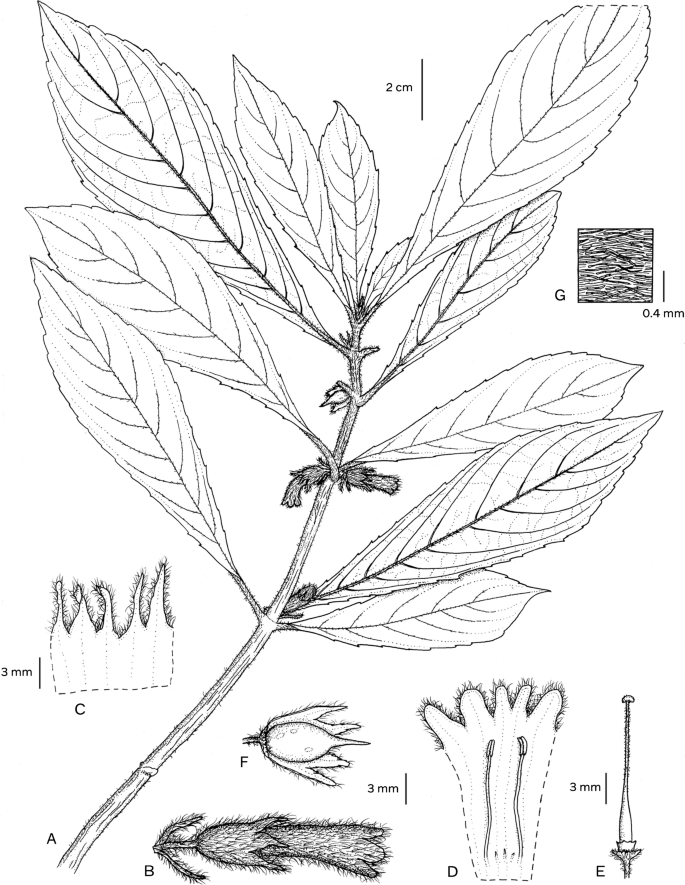
Cyrtandra menyamyana. A habit, flowering, leafy stem; B flower with bracts; C calyx, dissected; D corolla, dissected showing two stamens and three staminodes; E gynoecium with disk; F fruit with persistent calyx; G detail of calyx and corolla indumentum. All from Stevens & Streimann LAE 54845 (K [K001515731]). drawn by sebastian a. hatt.
recognition. Cyrtandra menyamyana is distinguished from all other New Guinea Cyrtandra by the combination of mostly subequal leaf pairs, with the major leaf oblanceolate with a crenate margin, a densely hairy yellowish-white calyx with acute to attenuate lobes, sometimes with 2 lobes slightly longer than other 3 and a densely hairy, creamy-white to orange-yellow corolla with lobes in 2+3 configuration.
distribution and habitat. Papua New Guinea. Morobe: a small area of mossy montane forest in the Menyamya-Aseki region, often in wet shaded areas; elev. 1700–2290 m. See Map 1.
specimens examined. papua new guinea. Morobe: Angabena ridge near Haumuga village, Aseki area, 1700 m, 31 March 1966, Schodde & Craven 4762 (CANB [CANB 167038], LAE [LAE124159]); E slope of Spreader Divide, c. 6 miles NW of Aseki, 1764 m, 20 April 1966, Schodde & Craven 4994 (A [A02313333], CANB [CANB 168486, CANB 168487], L [L.2823056], LAE [LAE207373]); Mepa R., above Wangini Village, near Aseki, Menyamya sub-distr., 2286 m, 14 May 1968, Streimann & Kairo NGF 35996 (E [E00632416], L [L.2823415], LAE [LAE105246]); Spreader Divide, between Aseki & Menyamya, Menyamya sub-distr., 1828 m, 20 Nov. 1970, Streimann & Kairo NGF 42443 (A [A02313446], BO [BO1975921], BRI, CANB [CANB 222425], E [E00632518], K [K001515635], L [L.2823486], LAE); Angabena ridge, Menyamya sub-distr., 1750 m, 10 Jan. 1972, Stevens & Streimann LAE 54845 (A [A02312976], BISH [BISH100214], BO [BO1975920], BRI [BRI AQ0353214], CANB [CANB 247660], E [E00632450, E00743820], K [K001515731], L [L.2823523], LAE, SING); Namtake, on ridge N of Aseki road, 1922–1944 m, 12 Oct. 1988, Takeuchi & Kiapranis 4191 (A [A02313075], BISH [BISH624787], CANB [CANB 00518142], E [E00311482, E00632555], LAE, MO).
conservation status. The last known collection of this species was in 1988. The EOO is 82 km2 and the AOO is 20 km2. All known collections of the species occur within the montane forests surrounding Aseki and, therefore, could be considered a single location (sensu IUCN 2022). Satellite imagery (Google Maps 2025) of the area suggests that the ridges to the west of Aseki are relatively intact. However, the hills around Angabena and NE of Aseki appear to have suffered considerably from smallholder farming and road development, suggesting continuing decline of the quality of habitat. From this preliminary appraisal, we provisionally assess Cyrtandra menyamyana as Critically Endangered [CR B1ab(iii)].
etymology. The epithet menyamyana is derived from the Menyamya subdistrict, the locality where this species is known to occur.
notes. This species appears to have a very narrow range, essentially restricted to the Aseki-Menyamya region, but is reported very common where found (see Stevens & Streimann LAE 54845).
Cyrtandra wagauensis S.Hatt & Bramley sp. nov. Type: Papua New Guinea. Morobe: Mt Shungol, about 5 miles SW of Wagau, 5000 ft (1520 m), 11 Dec. 1963, Hartley TGH 12489 (holotype K [K001515718]; isotypes A [A02312963], CANB [CANB 149423.1], L [L.2822979]).
http://www.ipni.org/urn:lsid:ipni.org:names:77367905-1
Small herb or shrub, spreading, c. 0.5 m tall. Stems woody towards base, faintly striate, glabrous to sparsely hairy on older stems, sparsely hairy to rarely densely hairy on very young growth. Leaves opposite, those of a pair strongly anisophyllous, with minor leaf absent or highly reduced. Major leaves, petioles (2 –) 3 – 5 (– 7) mm; blades lanceolate to narrowly lanceolate, (5 –) 6.5 – 10 cm; bases cuneate to attenuate; apices narrowly acuminate, acumen 14 – 19 mm long; margins irregularly but strongly toothed, often with every second tooth larger, larger teeth to 4 mm long; 5 – 6 pairs of lateral veins, tertiary venation reticulate, only faintly visible. Both leaves of a pair, adaxial surface dark green, glabrous; abaxial surface paler green, sparsely to densely hairy along midrib and secondary veins, mostly glabrous on blade. Minor leaf either absent, or linear, 2 – 3 × 0.5 – 1 mm, or rarely lanceolate, 3 – 4 times smaller than major leaf. Inflorescence sessile or on peduncle to 2 mm long, single in major leaf axils, 1-flowered. Bracts linear, 6 – 8 mm long, sparsely hairy, green, rapidly caducous. Pedicel (4 –) 5 – 8 mm long, reddish-brown, moderately hairy. Calyx red, 13 – 18 mm, sufficiently thick in the dried, pressed specimens to obscure the corolla, glabrous externally except for a sparse covering of very short hairs and raised hair bases at the lobe apices; lobes (4 –) 5; 2 shorter lobes, 2 – 3 mm long; 3 longer lobes, 4 – 6 mm long; lobes often splitting along connecting seams, such that calyx appears expanded, narrowly triangular to shortly acuminate. Corolla red, internal surface of lobes sometimes yellow; tubular, slightly to strongly infundibular, slightly arcuate, held erect, 18 – 26 mm long; lobes in 4+1 configuration; single lower lobe recurved, triangular, 5 – 6 × 5 – 6 mm long; upper lobes all 1 – 2 mm long; upper lateral lobes 2 – 3 mm long; corolla external surface with dense, short glandular hairs, with a sparser covering towards the base; internal surface of lobes glabrous except short glandular hairs on lobe apices. Filaments 18 – 20 mm long, glandular hairs along entire length, inserted 7 – 9 mm up from base of corolla. Anthers c. 2.5 mm, sometimes cohering at tip; staminodes absent to 3, 1.5 – 2 mm long. Gynoecium c. 19 mm long; ovary glabrous; disc cupular with very shallowly undulate margin, glabrous, 0.6 – 0.8 mm long; style densely covered in bulbous-based hairs towards apex; stigma capitate, margin with glandular hairs, surface papillose. Fruit green, 10 – 15 × 5 mm, elongate-ovate, glabrous, calyx and corolla not persistent. Seeds not seen. (Fig. 2).

Cyrtandra wagauensis. A habit, flowering, leafy stem; B flower, with bracts; C calyx, dissected; D corolla, dissected showing two stamens and three staminodes; E gynoecium with disk; F detail of corolla indumentum. All from Jermy 4635 (E [E00632480]). drawn by sebastian a. hatt.
recognition. Cyrtandra wagauensis is most similar to C. asekiensis S.Hatt & Bramley (ined.) of the Cyrtandra terrae-guilelmi complex (Hatt et al. in press). Both species have strongly anisophyllous pairs of leaves, leaves of a similar size (c. 5 – 10 cm) and shape (acuminate apices) and calyces that appear expanded or inflated. However, C. wagauensis can be distinguished by its predominantly glabrous calyx with the exception of a sparse covering of very short hairs and raised hair bases at the lobe apices (vs entirely hairy in C. asekiensis), calyx sufficiently thick to obscure the corolla behind it (vs thin enough to see the corolla behind it), corolla red (vs yellow or green) and distinctly infundibular (vs tubular, not infundibular) and the longer acumen on the major leaf at 14 – 19 mm long (vs to 12 mm long).
distribution and habitat. Papua New Guinea. Morobe: montane forest from Mt Shungol down the Kuper Range to around Wau; elev. 1500 – 1800 m. See Map 1.

Distribution of Cyrtandra menyamyana and C. wagauensis.
specimens examined. papua new guinea. Morobe: Mt Shungol, about 5 miles SW of Wagau, 5000 ft, 11 Dec. 1963, Hartley TGH 12489 (A [A02312963], CANB [CANB149423.1], K [K001515718], L [L.2822979]); Above Bouang SE of Wagau, c. 1500 m, 8 Jan. 1965, Jermy 4635 (E [E00632480]); Track to Mt Shungol, 19 km NE of Mumeng, 1800 m, 25 July 1979, Kairo 729 (A [A02312937], K [K001515437], L [L.2823663], LAE [LAE249896]); Skindiwai, Kuper Range, 21 km E of Wau, 1800 m, 21 Nov. 1981, Kairo 389 (A [A02312942], BRI [BRI AQ0422445], CBG [CBG 8315656.1], CNS [QRS 82457.1], E [E00632411], K [K001515419], L [L.2823355], LAE [LAE247934]).
conservation status. The last known collection of this species was in 1981. The EOO is 200 km2 and the AOO is 16 km2. All known collections of the species occur within the montane forests of the Kuper Range which constitute a single location (sensu IUCN 2022). Satellite imagery (Google Maps 2025) of the area suggests that significant areas of highland forest remain relatively intact. However, smallholder farming and road development is evident in the surrounding foothills and is encroaching on the primary forest. From this appraisal, we provisionally assess Cyrtandra wagauensis as Endangered [EN B1ab(iii)+2ab(iii)].
etymology. The epithet wagauensis is derived from the village of Wagau, which lies in the vicinity of the type locality.
notes. This species is likely closely related to the Cyrtandra terrae-guilelmi species complex (Hatt et al. in press) on account of its red corolla with lobes in 4+1 configuration. However, it is separated from this group of species by having an almost entirely glabrous calyx.
References
Atkins, H. J., Bramley, G. L. C. & Clark, J. R. (2013). Current Knowledge and Future Directions in the Taxonomy of Cyrtandra (Gesneriaceae), with a New Estimate of Species Number. Selbyana 31: 157 – 165. https://www.jstor.org/stable/24894287. [Accessed May 2025].
____, ____, Nishii, K., Möller, M., Olivar, J. E. C., Kartonegoro, A. & Hughes, M. (2021). Sectional polyphyly and morphological homoplasy in Southeast Asian Cyrtandra (Gesneriaceae): consequences for the taxonomy of a mega-diverse genus. Pl. Syst. Evol. 307: 60. https://doi.org/10.1007/s00606-021-01784-x.
____, Heatubun, C. D., Galloway, L. & Bramley, G. L. C. (2019) Two new species, Cyrtandra bungahijau and C. vittata, and notes on Cyrtandra (Gesneriaceae) from Yapen Island, Indonesia. Kew Bull. 74:29. https://doi.org/10.1007/s12225-019-9817-2.
____ & Kartonegoro, A. (2021). A taxonomic revision of Cyrtandra (Gesneriaceae) in Sulawesi, Indonesia. Edinburgh J. Bot. 78: 1 – 122. https://doi.org/10.24823/EJB.2021.364.
Bachman, S., Moat, J., Hill, A. W., de la Torre, J. & Scott, B. (2011). Supporting Red List threat assessments with GeoCAT: geospatial conservation assessment tool. ZooKeys 150: 117 – 126. Available from: http://geocat.kew.org/. https://doi.org/10.3897/zookeys.150.2109. [Accessed May 2025].
Beentje, H. J. (2016). The Kew plant glossary: an illustrated dictionary of plant terms, 2nd Ed. Kew Publishing, Richmond.
Bramley, G. L. C., Atkins, H. J., Kartonegoro, A. & Jimbo, T. (2024). An Annotated Checklist of Cyrtandra, Cyrtandropsis and Sepikea (Gesneriaceae) in New Guinea. Kew Bull. 79: 3 – 31. https://doi.org/10.1007/s12225-023-10151-7.
ESRI (2023). ArcGIS Pro 3.2.0. Available from: https://www.esri.com/en-us/home. Environmental Systems Research Institute, Inc., Redlands, CA. [Accessed May 2025].
Google Maps (2025). Satellite imagery of Papua New Guinea. Available from https://www.google.co.uk/maps/. [Accessed May 2025].
Hatt, S., Lamei, P. & Bramley, G. L. C. (in press). A revision of the red-flowered Cyrtandra terrae-guilelmi complex (Gesneriaceae) in New Guinea, with the description of five new species. Kew Bull. 81(3). https://doi.org/10.1007/s12225-025-10302-y
IUCN (2022). Guidelines for Using the IUCN Red List Categories and Criteria, Version 15.1. Prepared by the Standards and Petitions Committee, International Union for Conservation of Nature, Gland and Cambridge. Available from: https://www.iucnredlist.org/resources/redlistguidelines. [Accessed May 2025].
Kanehira, R. & Hatusima, S. (1943). The Kanehira- Hatusima 1940 Collection of New Guinea Plants. XVIII. Bot. Mag. (Tokyo) 57: 111 – 131. https://doi.org/10.15281/jplantres1887.57.111.
Lauterbach, K. (1910). Gesneriaceae, pp. 325 – 332. In: Nova Guinea. Résultats de l’expedition scientifique néerlandaise a la Nouvelle Guinée, Vol. 8, part 1. E. K. Brill, Leiden. https://www.biodiversitylibrary.org/item/42443#page/347/mode/1up. [Accessed May 2025].
____ (1912). Gesneriaceae, pp. 859 – 862. In: Nova Guinea. Résultats de l’expedition scientifique néerlandaise a la Nouvelle Guinée, Vol. 8, part 2. E. K. Brill, Leiden. https://www.biodiversitylibrary.org/item/42447#page/261/mode/1up. [Accessed May 2025].
McDade, L. A. (1995). Species concepts and problems in practice: insight from botanical monographs. Syst. Bot. 20 (4): 606 – 622. https://www.jstor.org/stable/2419813
Moore, S. (1916). Gesneriaceae, pp. 122 – 132. In: H. N. Ridley (ed.), Report on the Botany of the Wollaston Expedition to Dutch New Guinea, 1912 – 13. Trans. Linn. Soc. London, Bot. 9: 1 – 284. https://doi.org/10.1111/j.1095-8339.1916.tb00009.x.
Schlechter, R. (1923). Gesneriaceae Papuanae. Bot. Jahrb. Syst. 58: 255 – 379. https://www.biodiversitylibrary.org/item/95492#page/265/mode/1up
Schumann, K. (1905). Gesneraceae, pp. 373 – 385. In: Nachträge Flora der deutschen Schutzgebiete in der Südsee. Gebrüder Borntraeger, Leipzig. https://www.biodiversitylibrary.org/item/14420#page/371/mode/1up. [Accessed May 2025].
Thiers, B. (2025, continuously updated). Index Herbariorum: a global directory of public herbaria and associated staff. New York Botanical Garden's Virtual Herbarium. Available online from: http://sweetgum.nybg.org/science/ih/. [Accessed Aug. 2025].
Wagner, W. L., Wagner, A. J. & Lorence, D. H. (2013). Revision of Cyrtandra (Gesneriaceae) in the Marquesas Islands. PhytoKeys 30: 33 – 64. https://doi.org/10.3897/phytokeys.30.6147.
Acknowledgements
We thank the curators of the herbaria cited above for access to or loan of material.
Funding
Not applicable.
Author information
Authors and Affiliations
Contributions
Sebastian Hatt led the writing of the manuscript, with significant edits from Penniel Lamei and Gemma Bramley.
Corresponding author
Ethics declarations
Data Availability
All relevant data is contained in the text or on the specimens examined.
Conflicts of Interest
The authors declare no conflict of interest.
Additional information
Publisher's Note
Springer Nature remains neutral with regard to jurisdictional claims in published maps and institutional affiliations.
Rights and permissions
Open Access This article is licensed under a Creative Commons Attribution 4.0 International License, which permits use, sharing, adaptation, distribution and reproduction in any medium or format, as long as you give appropriate credit to the original author(s) and the source, provide a link to the Creative Commons licence, and indicate if changes were made. The images or other third party material in this article are included in the article's Creative Commons licence, unless indicated otherwise in a credit line to the material. If material is not included in the article's Creative Commons licence and your intended use is not permitted by statutory regulation or exceeds the permitted use, you will need to obtain permission directly from the copyright holder. To view a copy of this licence, visit http://creativecommons.org/licenses/by/4.0/.
About this article

Cite this article
Hatt, S.A., Lamei, P. & Bramley, G.L.C. Cyrtandra menyamyana and C. wagauensis (Gesneriaceae): two new species endemic to Papua New Guinea. Kew Bull (2026). https://doi.org/10.1007/s12225-025-10307-7
Accepted:
Published:
Version of record:
DOI: https://doi.org/10.1007/s12225-025-10307-7