

Summary
Cyrtandra J.R.Forst. & G.Forst. (Gesneriaceae) are widespread in New Guinea, with most of the ~92 species recognised species endemic to the island. However, New Guinea Cyrtandra have not received a taxonomic revision since Schlechter in 1923, who recognised 14 sections. A taxonomic revision of the red-flowered Cyrtandra terrae-guilelmi K.Schum. species complex (within Schlechter’s Cyrtandra sect. Loxanthe) is presented here, encompassing C. terrae-guilelmi (syn. C. schumanniana Schltr.), C. gorumensis Schltr., C. wilhelmensis P.Royen and five new species that are seemingly closely related: Cyrtandra asekiensis S.Hatt & Bramley, Cyrtandra buloloensis S.Hatt & Bramley, Cyrtandra ferruginicalyx S.Hatt & Bramley, Cyrtandra huonensis S.Hatt & Bramley and Cyrtandra milneensis S.Hatt & Bramley. This work forms part of a broader taxonomic revision of New Guinea Cyrtandra.
Introduction
Cyrtandra J.R.Forst. & G.Forst. is a highly diverse genus of herbs, epiphytes, shrubs and rarely small trees that is prominent in the rainforest understorey across its tropical Asian and Pacific distribution (Atkins et al. 2013). Comprising an estimated 800 species, Cyrtandra is the largest genus in the Gesneriaceae family (Atkins et al. 2013). With the exception of a small number of widespread species, most species are narrow endemics with restricted ranges (Atkins et al. 2021). The genus is characterised by having two fertile stamens and indehiscent fruits, with flower colour varying from white or green to bright red, yellow, orange, pink or purple.
As with other large tropical genera (SYZWG [Syzygium Working Group] 2016; Lucas et al. 2018; Muñoz‐Rodríguez et al. 2023), the vast size of Cyrtandra poses significant taxonomic challenges (Atkins et al. 2013). With the exception of Sulawesi (Atkins & Kartonegoro 2021), many hotspots of Cyrtandra diversity remain without taxonomic treatment (Atkins et al. 2013; Bramley et al. 2024). New Guinea, the region as circumscribed by Cámara-Leret et al. (2020), has 92 recognised species following a recent checklist (Bramley et al. 2024). However, this is likely a considerable underestimate given that herbarium collections of Cyrtandra from New Guinea are characterised by a large proportion of unidentified (Indet.) material. Furthermore, New Guinea is under-collected compared to other floristic regions within Southeast Asia (Middleton et al. 2019). 34 of the accepted species were described by Rudolf Schlechter in his Gesneriaceae Papuanae (1923). He classified New Guinea Cyrtandra into 14 sections, which remains the only available taxonomic framework for the region. Other botanists to contribute considerable numbers of new species were Karl Schumann (14) (1905), Karl Lauterbach (10) (1910, 1912), Spencer Moore (10) (1916), and Kanehira & Hatusima (5) (1943), with only a handful of new species described since then.
In contrast to the far western and eastern limits of the distribution of Cyrtandra where white or green flowers are common, species with brightly coloured red (sometimes tinted orange, purple or pink) flowers are relatively common in New Guinea (Atkins et al. 2021) and may be adapted for bird pollination. Schlechter’s Cyrtandra section Loxanthe Schltr. is characterised by strongly zygomorphic red flowers (up to 3 per leaf axil) that are externally brown-hairy, with a glabrous ovary and strongly anisophyllous leaves. Schlechter assigned eight species to this section: Cyrtandra behrmanniana Schltr., C. detzneriana Schltr., C. exserta K.Schum., C. gorumensis Schltr., C. lorentzii Lauterb., C. minjemensis Schltr., C. schumanniana Schltr. and C. terrae-guilelmi K.Schum.
During examination of collected material, it became apparent that the names ‘Cyrtandra terrae-guilelmi’ and ‘C. schumanniana’ have been applied broadly by various collectors across a diverse range of specimens, many of which did not match either type description. Further examination of unidentified material at numerous herbaria revealed several distinct and coherent groups of specimens with shared characters that are seemingly closely related to these two species.
Despite consultation of specimens from the entirety of New Guinea, all known specimens of species in this complex have been collected from Papua New Guinea. Although under-collection of plants from the Indonesian side of New Guinea remains a well-established fact (Middleton et al. 2019), narrow species distributions appear to be common in Cyrtandra (Atkins & Kartonegoro 2021; Bramley et al. 2024). Therefore, the narrow distributions of several species presented here may indeed reflect reality rather than an artefact of under-collection. Complete taxonomic revision of New Guinea Cyrtandra is urgently required before the biogeography of certain lineages can be accurately understood.
Here, we present an account of these closely related species that appear to form a: ‘Cyrtandra terrae-guilelmi species complex’ (Fig. 1). We synonymise C. schumanniana with C. terrae-guilelmi, and describe five new species to Papua New Guinea. We consider C. gorumensis and C. wilhelmensis as belonging to this complex and therefore additionally cover this species here. None of the other species in Cyrtandra sect. Loxanthe appear to belong to this complex, so are not covered here. This work forms part of a series of precursor revisions to a complete taxonomic circumscription of New Guinea Cyrtandra.

Photographs of fresh material of Cyrtandra terrae-guilelmi. A habit (SAJ0135); B floral morphology (SAJ0135); C floral morphology (de Kok 1268); D – E floral morphology (SAJ0809); F fruit (SAJ0809); G adaxial leaf surface (SAJ0809); H abaxial leaf surface (SAJ0809). Photographs of fresh material of C. wilhelmensis. J habit (Conn 5407); K floral morphology (Conn 5407). Photos: a – b, d – k Barry Conn; c Rogier de Kok.
Materials and Methods
This work is based on the examination of herbarium specimens from the following herbaria; in person: BISH (by specimen loan), BM, BO, CANB (by specimen loan), E, K, LAE, LY, P, SING, WRSL or digitally: A, BR, CANB, L, US. Herbarium acronyms follow Thiers (2024). Measurements were made from dried material, with flowers dissected following rehydration by soaking in 10% aqueous solution of Aerosol OT. Botanical terminology follows Beentje (2016). All cited specimens have been examined by the authors, either in digital or physical form, unless stated otherwise. Locality information is provided as written on the herbarium specimen labels. Due to the paucity of material available, measurements of floral parts were made from flowers that appeared to be closest to anthesis. However, as Cyrtandra flowers are protandrous there may be more variation in filament and style length than specified in the descriptions. Colours in descriptions follow collector’s notes on specimen labels and where possible from photographs seen by the authors.
We adopt a morphological species concept based on clear and consistent differences between species in three or more characters that are considered taxonomically informative (McDade 1995). Following other recent taxonomic works in the genus (Wagner et al. 2013; Atkins & Kartonegoro 2021), we consider the following characters to be taxonomically informative for the Cyrtandra terrae-guilelmi complex and associated Cyrtandra: leaf shape, anisophylly (the extent to which leaves of a pair differ from each other in size and shape); flower size, position and number; bract presence/absence; calyx presence/absence, size and lobe number, shape and indumentum. Type specimen selection was decided based on age (older specimens preferred), quality (higher quality preferred), number of duplicates (higher preferred) and representativeness (demonstrating more representative characters preferred). In most cases, from a set of specimens in a chosen type collection, the Kew specimen was selected for the holotype as they typically held an abundance of flowering material. In each case, one of these flowers has been dissected by the authors and thus internal floral characters are readily available for examination.
Suggested IUCN conservation categories were assigned following the guidelines of the IUCN Red List Categories and Criteria (IUCN 2024). Extent of occurrence (EOO) and area of occupancy (AOO) were estimated where possible using GeoCAT, using a 2 × 2 km grid cell (Bachman et al. 2011). Given the paucity of collections from Papua New Guinea, these estimations may be underestimates in some cases due to poor numbers of collections.
Distribution maps were generated using ArcGIS Pro 3.2 (ESRI 2023) from co-ordinate data geo-referenced from herbarium specimens.
Taxonomic Treatment
Characters defining the Cyrtandra terrae-guilelmi complex are briefly described:
Herbs or shrubs. Stems woody towards base, faintly striate, glabrous but sparsely hairy on young growth. Leaves opposite, strongly anisophyllous to subequal. Inflorescence sessile or on short peduncle, in leaf axils of major and/or minor leaf, 1 – 3-flowered. Bracts absent, or if present, linear, densely covered in hairs. Calyx absent or if present red, rarely green or yellow, lobes (3 –) 5. Corolla red, rarely green, yellow or cream, tubular, slightly arcuate, held erect, lobes in 4+1 configuration, lower lobe recurved; external surface of corolla with dense, short glandular hairs, with a sparser covering towards the base; interior surface of lobes hairy but tube glabrous. Gynoecium ovary glabrous, nectary disk cupular or unilateral.
Key to species of the Cyrtandra terrae-guilelmi complex (see Fig. 2 for visual aid)

Comparison of leaf (upper row) and flower morphology (lower row) across the Cyrtandra terrae-guilelmi species complex. A Cyrtandra asekiensis from Stevens 54789; B C. buloloensis from Floyd 7461; C C. ferruginicalyx from Millar NGF 40751; D C. gorumensis from Schlechter 18533; E C. huonensis from Hoogland 9241; F C. milneensis from Brass 22999; G C. terrae-guilelmi from Hartley TGH 10533; H C. wilhelmensis from Hoogland 9547.
-
1. Calyx apparently absent............................................. 2
-
1. Calyx clearly present............................................. 3
-
2. Calyx completely absent; flowers with bracts 5 – 9 mm long; leaf pair anisophylly variable with minor leaf in subequal leaf pairs typically ¼ to full size or major leaf; leaves 2 – 4.5 cm wide; nectary disc unilateral............................................. 8. C. wilhelmensis
-
2. Calyx present in most flowers, inflated, rarely absent; flower without bracts; leaf pairs strongly anisophyllous with minor leaf absent or strongly reduced; leaves 1.5 – 2.2 cm wide; nectary disc cupular............................................. 5. C. huonensis
-
3. Calyx predominantly (3 –) 4-lobed............................................. 4
-
3. Calyx 5-lobed............................................. 5
-
4. Leaf pair anisophylly variable with minor leaf in subequal leaf pairs typically ¼ to full size of major leaf; leaf apex shortly acuminate to acuminate, acumen to 15 (– 18) mm; calyx 7 – 12 (– 15) mm long, lobes 1.5 – 6 mm long; pedicel 6 – 10 mm long; nectary disc unilateral............................................. 3. C. ferruginicalyx
-
4. Leaf pair strongly anisophyllous or rarely unequal with minor leaf strongly reduced or rarely ½ the size of major leaf; leaf apex acuminate to narrowly acuminate, acumen c. 30 mm long; calyx 14 – 17 mm long, lobes 6 – 9 mm long; pedicel 10 – 22 mm long; nectary disc cupular............................................. 4. C. gorumensis
-
5. Calyx lobes less than ⅕ the length of the calyx, (1 –) 2 – 3 mm long, triangular............................................. 2. C. buloloensis
-
5. Calyx lobes usually significantly more than ⅕ the length of the calyx, > 4 mm long, triangular to acuminate............................................. 6
-
6. Calyx strongly inflated, often twice as wide as the corolla............................................. 7
-
6. Calyx not strongly inflated, just wider than the corolla............................................. 8
-
7. Bracts absent; major leaf in a pair 8 – 12 cm long; calyx lobes very narrowly acuminate to almost linear............................................. 5. C. huonensis
-
7. Bracts 4 – 8 mm long; major leaf in a pair 5 – 9.5 cm long; calyx lobes acuminate from a triangular base............................................. 1. C. asekiensis
-
8. Calyx 23 – 28 mm long; corolla 30 – 34 mm long; leaf pairs mostly subequal............................................. 6. C. milneensis
-
8. Calyx 10 – 21 mm long; corolla 14 – 26 mm long; leaf pairs strongly anisophyllous............................................. 7. C. terrae-guilelmi
In the following treatment, species are arranged alphabetically.
1. Cyrtandra asekiensis S.Hatt & Bramley sp. nov. Type: Papua New Guinea. Morobe, Mepa River, above Wangini Village, near Aseki, Menyamya Sub-district, 7500 ft, 14 May 1968, Streimann & Kairo NGF 35997 (holotype K [K001515640]; isotypes A [A02312985], BO [BO1981958], BRI [BRI AQ0221559], CANB [CANB197690], E [E00632704], L [L2823420], LAE [LAE105245], NSW, SING). (Fig. 3).
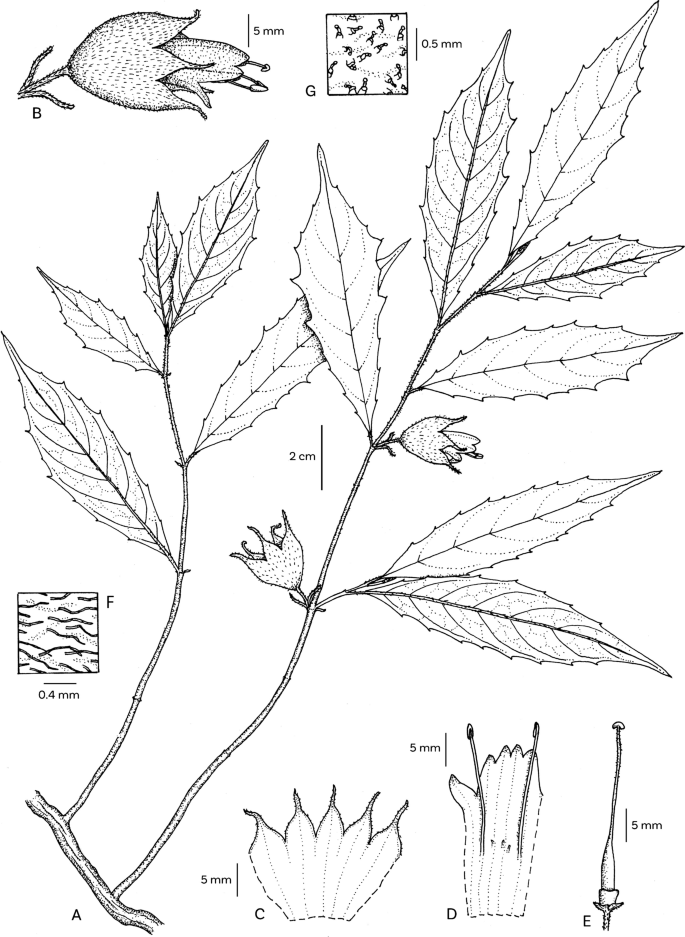
Cyrtandra asekiensis. A habit, flowering, leafy stem; B flower with bracts; C dissected calyx; D dissected corolla showing two stamens and three staminodes; E gynoecium with disk; F detail of calyx indumentum; G detail of corolla indumentum. All from Streimann & Kairo NGF 35997. Drawn by Sebastian A. Hatt.
http://www.ipni.org/urn:lsid:ipni.org:names:77379475-1
Small, erect herb or small shrub, c. 0.15 m tall. Stems woody towards base, faintly striate, glabrous but sparsely hairy on young growth. Leaves opposite, those of a pair strongly anisophyllous with minor leaf absent or strongly reduced; petioles of major leaf 5 – 6 (– 8) mm long; blades of major leaf lanceolate to narrowly lanceolate, 5 – 9.5 × 1.5 – 2.5 cm, apex acuminate, acumen to 12 mm long, base cuneate-rounded to attenuate; margin with irregularly but prominent teeth, with every second tooth larger, larger teeth to 2 mm long; 5 – 8 pairs of lateral veins, tertiary venation reticulate, only faintly visible; adaxial surface dull dark green, glabrous; abaxial surface pale green, blade mostly glabrous, veins with hairs. Minor leaf absent or if present, linear, 5 – 8 mm long. Inflorescence sessile or on peduncle to 4 mm long, in leaf axils, 1-flowered. Bracts linear, 4 – 8 mm long, densely covered in hairs. Pedicel (3 –) 5 – 11 × c. 1 mm long, sometimes flattened, densely covered in hairs. Calyx red, (12 –) 15 – 23 mm long, hairy externally; lobes 5, lobes 4 – 8 mm long, acuminate from a triangular base. Corolla yellow, green or red with yellow tip; tubular, slightly arcuate, held erect, (15 –) 25 – 30 mm long, lobes in 4+1 configuration, lower lobe recurved, triangular, upper lobes 2 – 2.5 × 2 – 2.5 mm, lateral lobes 3 – 7 mm, lower lobe 5 – 6 mm; external surface of corolla with dense, short glandular hairs, with a sparser covering towards the base; interior surface of lobes hairy but tube glabrous. Filaments glabrous, c. 17 mm long, curved, inserted c. 6 mm up from base of corolla. Anthers 2 – 3 mm long, sometimes observed cohering at tip, not exserted or exserted; staminodes present, 1 – 3 mm long. Gynoecium c. 26 mm long; ovary glabrous; disc cupular with undulate margin, glabrous, c. 2 mm long; style densely covered in bulbous-based hairs towards apex; stigma discoid, glabrous. Fruit not seen. Seeds not seen.
recognition. Cyrtandra asekiensis S.Hatt & Bramley is most similar to C. huonensis S.Hatt & Bramley. Both species have a pair of strongly anisophyllous leaves, the major leaf narrowly lanceolate, an inflated calyx. However, C. asekiensis can be distinguished by having bracts 4 – 8 mm (vs absent), calyx lobes acuminate from a triangular base (vs very narrowly acuminate to almost linear), acuminate leaf apices (vs narrowly acuminate), and a yellow, green or red but tipped yellow corolla (vs red).
distribution. Papua New Guinea. Morobe: a small area of montane forest in the Menyamya-Aseki region. See Map 1.

Distribution of species described in this article.
specimens examined. papua new guinea. Morobe: Mepa R., above Wangini Village, near Aseki, Menyamya Sub-distr., 7500 ft, 14 May 1968, Streimann & Kairo NGF 35997 (A [A02312985], BO [BO1981958], BRI [BRI AQ0221559], CANB [CANB197690], E [E00632704], K [K001515640], L [L2823420], LAE [LAE105245], NSW, SING); Spreader Divide, between Aseki and Menyamya, Menyamya Sub-distr., 6300 ft, 21 Nov. 1970, Streimann & Kairo NGF 42466 (A [A02313049], BRI [BRI AQ0353118], CANB [CANB222536], E [E00632515], K [K001515700], L [L2823485]); Aseki-Spreader Divide, Menyamya Sub-distr., 1830 m, 8 Jan. 1972, Stevens LAE 54789 (A [A02312979], BO [BO1979803], BRI [BRI AQ0353277], CANB [CANB247571], K [K001515682], L [L2823490], SING, SYD); Menyamya-Asiki, 2000 m, 8 July 1988, Lapré 146 (L [L4428850, L4428851], LAE [LAE301936]).
habitat. Damp, shady areas in forest on creeks and ridges; elev. 1830 – 2290 m.
conservation status. The last known collection of this species was in 1972. The extent of occurrence (EOO) is 24 km2 and area of occupancy (AOO) is 16 km2. All known collections of the species occur within a very restricted area, and can be considered a single location. Satellite imagery (Google Maps 2025) of the area suggests that about half of the land in that area remains untouched, particularly the ridges. However, the other half appears to have suffered from smallholder farming and road development, suggesting continuing decline of the quality of habitat. From this preliminary appraisal, we assess Cyrtandra asekiensis as Critically Endangered (CR) under criteria B1ab(iii).
etymology. The epithet asekiensis is derived from the Aseki region, the locality where this species is known to occur.
notes. This species is unusual in this complex for having a yellow to green corolla (vs red). Three specimens (Streimann & Kairo 35997; Stevens 54789; Streimann & Kairo 42466) report flower colour: ‘yellow’, ‘green’, and ‘red tipped yellow’ respectively. Further collections of this species are required to better understand flower colour variation, including whether yellow or green are common flower colours for the species, versus red, and to what extent colour changes throughout the development of the flower.
2. Cyrtandra buloloensis S.Hatt & Bramley sp. nov. Type: Papua New Guinea. Morobe, 1955 Planting Area, Bulolo, 1060 m, 9 June 1955, Floyd NGF 7461 (holotype K [K001515482], isotypes, A [A02313501], BM, BO [BO1982085], BRI [BRI AQ0221718], CANB [CANB59760, CANB59761], L [L2823309], LAE [LAE17961], SING [SING0200973], US [US00081183]). (Fig. 4).
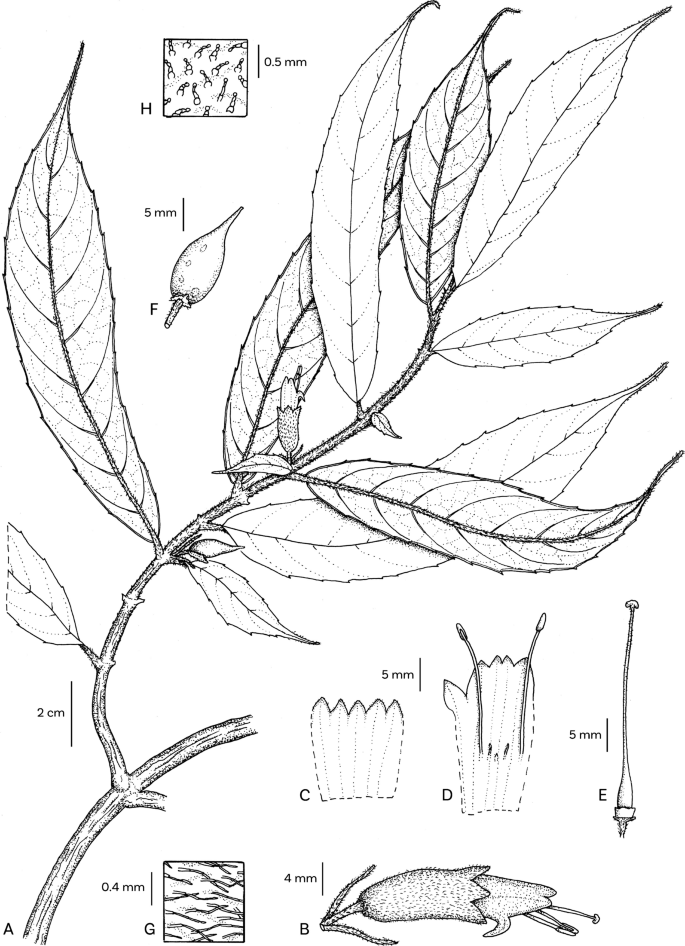
Cyrtandra buloloensis. A habit, flowering, leafy stem; B flower with bracts; C dissected calyx; D dissected corolla showing two stamens and three staminodes; E gynoecium with disk; F mature fruit; G detail of calyx indumentum; H detail of corolla indumentum. All from Floyd 7461. Drawn by Sebastian A. Hatt.
http://www.ipni.org/urn:lsid:ipni.org:names:77379476-1
Small shrub, 1.2 – 1.5 m tall. Stems woody towards base, striate, sparsely hairy on older stems, very dense on younger growth. Leaves opposite, those of a pair often strongly anisophyllous; petioles of major leaf (2 –) 4 – 8 (– 11) mm long; blades of major leaf in subequal leaf pairs elliptic-oblanceolate to narrowly lanceolate, (8 –) 10 – 18 × 2 – 5 cm, apex narrowly acuminate, acumen c.15 mm, base rounded, rarely cuneate, symmetrical; margin faintly, shallowly toothed, often irregularly spaced; 6 – 9 pairs of lateral veins, tertiary venation visible, faint to well-defined; adaxial surface dull dark green, glabrous; abaxial surface pale to dark tan, with hair covering all parts. Minor leaf absent or like major but smaller and reduced to 5 – 30 mm long. Inflorescence sessile, in leaf axils, 1 – 2 (– 5)-flowered. Bracts linear, 2 (– 3) per flower, 6 – 12 mm long, densely covered with rusty brown hairs, green when alive. Pedicel 3 – 8 mm long, densely covered with rusty brown hairs. Calyx deep red, (10 –) 14 – 18 mm long, moderately covered with rusty brown hairs, 5-lobed, lobes mostly equal, (1 –) 2 – 3 mm long, triangular. Corolla red to orange-red, tubular, narrowing sharply at apex when dry, slightly arcuate to straight, held erect, 21 – 27 mm long, lobes in 4+1 configuration, lower lobe strongly recurved, triangular, upper lobes 1 – 2 × 1 – 2 mm, lateral lobes 1 – 2 × 5 – 8 mm, lower lobe 5 – 8 × 2 – 5 mm; external surface of corolla with dense short glandular hairs with a sparser covering towards the base; interior surface of lobes hairy but tube glabrous. Filaments glabrous, c. 20 mm long, white, inserted c. 6 mm up from base of corolla. Anthers 1 – 2 mm long, not observed cohering at tip, not exserted to exserted to c. 15 mm beyond corolla. Gynoecium 30 – 35 mm long; exserted beyond corolla; ovary glabrous; disc cupular, with very faintly undulate margin, c. 1.5 mm long; style glandular hairy; stigma discoid, glabrous. Fruit green, glabrous, ovoid-acuminate, to 17 × 6 – 8 mm, calyx persistent but split, corolla persistent but split. Seeds many, small.
recognition. Cyrtandra buloloensis S.Hatt & Bramley is most similar to C. terrae-guilelmi K.Schum. Both species have a pair of strongly anisophyllous leaves of a similar shape and size. However C. buloloensis but can be distinguished by its very short calyx lobes (2 – 3 vs 4 – 9 mm) that are triangular (vs acuminate to narrowly acuminate) and consistently less than ⅕ the total length of the calyx (vs always >¼ the length).
distribution. Papua New Guinea. Morobe: in lowland forests from Bulolo northwards to Markham River and Labu. See Map 1.
specimens examined. papua new guinea. Morobe: Buang Track above Gabensis, 730 m, 20 May 1955, Floyd NGF 7306 (A [A02313376], BO [BO1979877, BO1979808], BRI [cited as duplicate on specimen but not found online], K [K001515661], L [L2823315], LAE [LAE17953], SING [SING0200961]); 1955 Planting Area, Bulolo, 1060 m, 9 June 1955, Floyd NGF 7461 (A [A02313501], BM, BO [BO1982085], BRI [BRI AQ0221718], CANB [CANB59760, CANB59761], K [K001515482], L [L2823309], LAE [LAE17961], MEL [MEL 0058253 A], SING [SING0200973], US [US00081183]); Patep Creek, 750 m, 29 March 1960, Millar NGF 12211 (A [A02313043], BO [BO1981213], BRI [BRI AQ0221569], CANB [CANB99108], K [K001515728], L [L2822865], LAE [LAE43198]); Wampit R., 365 m, 26 Feb. 1964, Millar NGF 23278 (A [A02313328], BO [BO1979629], BRI [cited as duplicate on specimen but not found online], CANB [CANB169455], E [E00632653], K [K001515619], L [L2823338], LAE [LAE79275], NSW, SING [SING0200948], UH); Above camp No. 8 Bulolo, 1340 m, 25 Oct. 1965, Streimann & Kairo NGF 26013 (A [A02313314], BFC, BISH, BO [BO1979953], CANB [CANB183845], K [K001515606], L [L2823650], LAE [LAE85309], PNH, SING, SYD, UH, US [US00081123]); Palenkwa, Golden Pines, 1005 m, 24 April 1969, Streimann & Kairo NGF 39393 (A [A02313041], BRI [BRI AQ0221768], K [K001515646], L [L2823362]); Labu Swamp, 4WD access road in alluvial border community, 100 m, 26 July 1991, Takeuchi 7209 (A [A02312907], E [E00274681]); Logging road near Markham Village, along margin of Labu Swamp, 50 – 100 m, 26 July 1991, Takeuchi 7209 (A [A02313354], L [L3805853]).
habitat. Undergrowth of forest, sometimes disturbed; elev. (50 –) 730 – 1340 m. Only two collections, made at the same locality on the same day, both labelled ‘Takeuchi 7209’, were made from a much lower elevation than all other specimens. Further collections are required to better understand the elevational range of this species.
conservation status. The last known collection of this species was in 1991. The extent of occurrence (EOO) is 1,153 km2 and area of occupancy (AOO) is 28 km2. These comprise no more than four separate locations. Satellite imagery of the area (Google Maps 2025) suggests that some of the populations occur along the Bulolo valley, which has been heavily developed, with clear encroachment of agricultural land into the mountains. However, the more northern populations closer to Lae were collected in forests that appear less disturbed. From this preliminary appraisal, we assess Cyrtandra buloloensis as Endangered (EN) under criteria B1ab(iii)+2ab(iii).
etymology. The epithet buloloensis is derived from the Bulolo Valley, where the type specimen of this species was collected.
3. Cyrtandra ferruginicalyx S.Hatt & Bramley sp. nov. Type: Papua New Guinea. Eastern Highlands, Fatima river, Marafunga, 2440 m, 13 Nov. 1968, Millar NGF 40751 (holotype K [K001515735], isotypes A [A02313113], BO, BRI [BRI AQ0221547], CANB [CANB199755], E [E00632681], L [L2823015], LAE [LAE302240], SING [SING0200952]). (Fig. 5).

Cyrtandra ferruginicalyx. A habit, flowering, leafy stem; B flower with bracts; C dissected calyx; D dissected corolla showing two stamens and three staminodes; E gynoecium with disk; F detail of calyx indumentum. All from Womersley & Floyd 6917. Drawn by Sebastian A. Hatt.
http://www.ipni.org/urn:lsid:ipni.org:names:77379477-1
Small shrub, terrestrial or epiphytic on base of trees, 0.45 – 1.5 (– 2) m tall. Stems woody towards base, striate, sparsely hairy on young growth, glabrous on older growth. Leaves opposite, anisophylly variable with minor leaf in subequal leaf pairs typically ¼ to full size of major leaf; petioles of major leaf (6 –) 8 – 20 (– 40) mm long; blades of major leaf lanceolate to broadly lanceolate, 4 – 13 (– 21) × 1.5 – 5 (– 7) cm, apex shortly acuminate to acuminate, acumen to 15 (– 18) mm long, base cuneate, symmetrical; margin faintly, shallowly toothed, often irregularly spaced; 4–8 pairs of lateral veins, tertiary venation faint to prominent; adaxial surface dark, reddish dark-green when dried, mostly glabrous, pubescent on young leaves; abaxial surface pale to dark tan, with hairy covering all parts, denser on midrib. Minor leaf absent or like major but smaller and reduced. Inflorescence subsessile or on peduncle to 5 mm long, in leaf axils, 1 – 2-flowered. Bracts linear, 2 per flower, 3 – 9 mm long, densely covered with rusty brown hairs. Pedicel 6 – 10 mm long, densely covered with rusty brown hairs. Calyx purple to dull red, but appearing orange-brown from the dense hairs, 7 – 12 (– 15) mm long, extremely densely covered in light orange-brown hairs, (3 –) 4-lobed; lobes mostly 2 × 2, often deeply divided between the two pairs of lobes, 1.5 – 3 × 3 – 6 mm, triangular, acute. Corolla magenta to reddish-purple to purplish-pink, tubular, slightly arcuate to straight, held erect, 18 – 26 (– 35) mm long, lobes in 4+1 configuration, lower lobe strongly recurved, triangular, upper lobes 1 – 2 × 1 – 2 mm across, lateral lobes 1 – 2 × 4 – 5 mm, lower lobe 3 – 5 × 3 – 5 mm; external surface of corolla with dense, short glandular hairs with a sparser covering towards the base; interior of lobes hairy but tube glabrous. Filaments mostly glabrous with very sparse glandular hairs, c. 17 mm long, white, inserted c. 8 mm up from base of corolla. Anthers white to cream-brown, 1.5 – 3 mm long, not observed cohering at tip, not exserted to exserted to c. 7 mm beyond corolla. Gynoecium c. 30 mm long; style not exserted to exserted to 2 mm beyond corolla; ovary glabrous; disc unilateral, margin often deeply lobed, c. 3 mm long; style white, glandular hairy; stigma discoid, glabrous. Fruit green, glabrous, ovoid, c. 15 × 5 mm, calyx persistent but split, corolla persistent but split. Seeds many, small.
recognition. Cyrtandra ferruginicalyx S.Hatt & Bramley is most similar to C. gorumensis Schltr. Both species have a (3 –) 4-lobed calyx densely covered in long rusty orange-brown hairs. However C. ferruginicalyx but can be distinguished by the variable anisophylly of its leaf pairs (vs strongly anisophyllous), its calyx 7 – 12 (– 15) mm long (vs 14 – 17 mm long), its pedicel 6 – 10 mm long (vs 10 – 22 mm long), its unilateral disc (vs cupular) and the leaf apex shortly acuminate to acuminate (vs acuminate to narrowly acuminate). It is also similar to C. wilhelmensis. Both species have leaves with variable anisophylly and a unilateral nectary disc. However, C. ferruginicalyx can be distinguished by the presence of its 4-lobed calyx (vs calyx absent).
distribution. Papua New Guinea. Eastern Highlands near Goroka, and the southern slopes of the Finisterre Range. See Map 1.
specimens examined. papua new guinea. Eastern Highlands: Goroka, J. Leahey’s Logging area, near Goroka, 7300 ft, 18 Nov. 1954, Womersley & Floyd 6171 (LAE [LAE17903]); Goroka sub-distr., ridge above Daulo, 2560 m, 22 Nov. 1954, McKee & Floyd 6705 (A [A02313233], K [K001515421], LAE [LAE17940]); Ridge above Daulo, 2600 m, 22 Nov. 1954, McKee 1415 (K [K001515734]); Asaro-Mairi Divide, near Daulo camp, 2400 m, 22 June 1956, Hoogland & Pullen 5414 (A [A02313345], BM, BRI [cited as duplicate on specimen but not found online], CANB [CANB59418], K [K001515652], LAE [LAE17823], MEL [MEL 0577941 A], US [US00081199]); Asaro-Mairifutica divide, c. 2440 m, 3 Aug. 1957, Pullen 441 (CANB [CANB43801, CANB43802]; L [L2823287], LAE [LAE30048]); Mt Otto, south slopes, 2200 m, 14 Aug. 1959, Brass 31055 (LAE [LAE37838], US [US00081160]); Marafunga Logging Area, Chimbu divide, 2500 m, 6 Sept. 1961, Womersley & Sleumer NGF 13963 (A [A02313415], BM, BRI [BRI AQ0221750], CANB [CANB100330], K [K001515729], LAE [LAE35658], SING [SING0200962]); Marafunga, 2740 m, 29 Aug. 1963, Millar & van Royen NGF 15964 (L [L2822989], LAE [LAE62463]); Kanawyroka Creek, Goroka sub-distr., 7500 ft, 30 Aug. 1963, Millar & van Royen NGF 15990 (BRI [BRI AQ0221595], L [L2823657], LAE [LAE62430]); Fatima River Valley, 2380 m, 27 May 1965, Millar NGF 22550 (BRI [BRI AQ0353106], CANB [CANB170690], E [E00632680], L [L2822950], LAE [LAE78531]); Fatima R., near Marafunga, 1524 – 1829 m, 21 May 1968, Woods 1211 (E [E00632499], LAE [LAE260253]); N side of Fatima R., 1524 – 1829 m, 22 May 1968, Woods 1292 (E [E00623487], LAE [LAE260255]); Fatima R., Marafunga, 2440 m, 13 Nov. 1968, Millar NGF 40751 (A [A02313113], BO, BRI [BRI AQ0221547], CANB [CANB199755], E [E00632681], K [K001515735], L [L2823015], LAE [LAE302240], SING [SING0200952]); Marafunga, extension area 1 by R. Fatima, 2575 m, 2 Nov. 1970, Stevens LAE 51051 (A [A02313443], BRI [BRI AQ0221777], CANB [CANB222682], E [E00632694], L [L2823551]); Marafunga, 2590 m, 12 April 1971, Stone LAE 35287 (BRI [BRI AQ0353132], CANB [CANB226235], L [L2822996]). Central Highlands: Korofunota via Goroka, 2360 m, 22 Nov. 1954, Womersley & Floyd 6917 (A [A02313234], BM, CANB [CANB59758, CANB59757], K [K001515420], LAE [LAE17939], SING [SING0202150]). Madang: Upper southern slopes of the Finisterre Range, between Sewe and Mt Abilala, 2390 m, 6 Nov. 1964, Pullen 6051 (BM, CANB [CANB154600, CANB154601], E [E00632686], LAE [LAE82545]); Saidor sub-distr., Naho-Rawa divide, Sewe, 2440 m, Nov. 1964, Jermy 4195 (BM); Saidor sub-distr., Naho-Rawa divide, Sewe, 2440 m, 11 Nov. 1964, Sayers 21366 (BM).
habitat. Upper montane forest; elev. 2200 – 2740 m.
conservation status. The last known collection of this species was in 1971. The extent of occurrence (EOO) is 1,283 km2 and area of occupancy (AOO) is 32 km2. There are two populations (or threatened locations), one in the Finisterre Range and one in the Goroka region. Given the species is only known from upper montane forest above 2200 m, the large Ramu Valley between these localities likely fragments the species into two isolated populations. Satellite imagery (Google Maps 2025) shows the area around Goroka has been heavily disturbed and deforested, leaving only limited areas with undisturbed forest cover. As this species grows in montane forests at high elevations (2200 – 2740 m), populations at the higher end of their range may be more protected as this land is less likely to be suitable for cultivation. From this preliminary appraisal, we assess Cyrtandra ferruginicalyx as Endangered (EN) under criteria B1ab(iii)+2ab(iii).
etymology. The epithet ferruginicalyx is derived from the Latin: ferruginus, meaning ‘rust-coloured’, referring to the rust-coloured hairs on the calyx.
notes. This species appears to be separated into two populations either side of the Ramu River valley. Specimens collected from the population in the Finisterre Range appear to have larger leaves and longer petioles, and may therefore be genetically isolated from the population near Goroka.
Several specimens (McKee 1415; Womersley & Sleumer 13963; McKee & Floyd 6705; Sayers 21366) report this species as ‘epiphytic’ or ‘sometimes epiphytic’, presumably on trees. Further observations are required to clarify the extent of epiphytic behaviour in this species.
4. Cyrtandra gorumensis Schltr. (Schlechter 1923: 351); Bramley et al. (2024: 13). Type: Papua New Guinea. Morobe, In den Nebelwäldern des Bismarck-Gebirges (Gorum der Eingeborenen), 1100 m, Oct. 1908, Schlechter 18533 (lectotype, designated in Bramley et al. (2024: 13): K [K000831703]; isolectotypes BR [BR0000005173105], photo at E [E00062670], K [K001515853], LY [LY0474345, LY0474346, LY0772852, LY0772853, LY0772854], P [P93555513]) – Schlechter 18333 (LY [LY0474345]) is likely a typographic error of Schlechter 18533 as the date of collection is shared and the specimen looks identical. (Fig. 6).

Cyrtandra gorumensis. Isolectotype (Schlechter 18533 [mistakenly written as 18333]; LY0474345). A flower is enlarged for closer inspection. © Lyon Herbarium.
Small, erect subshrub, 0.5 – 1 m tall. Stems woody towards base, striate, glabrous but hairy on younger stems. Leaves opposite, those of a pair strongly anisophyllous or rarely unequal with minor leaf strongly reduced or rarely half the size of major leaf; petioles of major leaf (5 –) 10 – 16 mm long; blades of major leaf lanceolate, 7 – 16 × 2 – 3.5 (– 5) cm, apex acuminate to narrowly acuminate, acumen c. 30 mm long, base cuneate to rounded; margin with shallow, regularly and widely spaced serrate teeth; 6 – 7 pairs of lateral veins, tertiary venation reticulate, barely visible; adaxial surface dull dark green (when dried), glabrous; abaxial surface pale tan-green (when dried), blade glabrous, veins with sparse hairs. Minor leaf absent or if present, linear, to 4 mm, or rarely ½ the size of major leaf. Inflorescence sessile, in leaf axils, 1- (– 2)-flowered. Bracts linear, 6 – 10 mm long, densely covered in dark brown hairs. Pedicel 10 – 22 mm long, densely covered in dark brown hairs. Calyx colour not known, 14 – 17 mm long, densely covered in long, rusty brown hairs; lobes (3 –) 4 (– 5), lobes 6 – 9 mm long, narrowly triangular. Corolla pink to red, tubular, arcuate, held erect, 19 – 25 mm long, lobes in 4+1 configuration, lower lobe recurved, triangular, upper lobes 2 × 2 mm, lateral lobes 2 × 5 mm, lower lobe 4 – 7 × 4 – 7 mm; external surface of corolla with dense, short bulbous-based hairs, with a sparser covering towards the base; interior surface of lobes sparsely hairy but tube glabrous. Filaments glabrous, c. 23 mm long, curved, inserted 6 – 7 mm up from base of corolla. Anthers 1.5 – 2 mm long, sometimes observed cohering at tip, not exserted to exserted 2 – 3 mm beyond corolla; 2 – 3 staminodes present, 2 – 3 mm long. Gynoecium 17 – 25 mm long; ovary glabrous; disc cupular, with irregularly undulate margin, glabrous, c. 1.5 mm long; style glandular hairy with bulbous-based hairs towards apex; stigma discoid, mostly glabrous. Fruit not seen. Seeds not seen.
recognition. See Cyrtandra ferruginicalyx S.Hatt & Bramley for similarities.
distribution. Papua New Guinea. Morobe: Bismarck Range. See Map 1.
specimens examined. papua new guinea. Morobe: In den Nebelwäldern des Bismarck-Gebirges (Gorum der Eingeborenen), 1100 m, Oct. 1908, Schlechter 18533 (BR [BR0000005173105], photo at E [E00062670], K [K000831703, K001515853], LY [LY0474345, LY0474346, LY0772852, LY0772853, LY0772854], P [P93555513]– Schlechter 18333 (LY [LY0474345]) is likely a typographic error of Schlechter 18533 as the date of collection is shared and the specimen looks identical; Bismarck Gebirges, 2000 m, 14 Nov. 1908, Schlechter 18739 (BR [BR0000005173426], K [K000831704], LY [LY0474344, LY0474347, LY0474348, LY0772860, LY0772861, LY0772862, LY0772863, LY0772864, LY0772865, LY0772866, LY0772867, LY0772868, LY0772869], P [P03555512]); Mt Wilhelm, Plot 1200 A, 1200 m, 4 Nov. 2012, Molino 3025 (P [P02433625]).
habitat. Montane forest; elev. 1100 – 2200 m.
conservation status. The last known collection of this species was in 2012, from a forest plot near Mt Wilhelm. Schlechter’s collections state: ‘Bismarck Range’ as the locality, so it is unclear where exactly this was collected. However, his two collections of this species are almost 1000 m apart in elevation. As only one locality has co-ordinates, the extent of occurrence (EOO) and area of occupancy (AOO) cannot be calculated. The lack of any other collections of the species suggests it may be relatively rare. Although Mt Wilhelm itself is a protected area, most of the surrounding rainforests lie outside this zone and are owned by local indigenous people. Satellite imagery (Google Maps 2025) reveals that much of this rainforest has already been deforested. From this preliminary appraisal, we assess Cyrtandra gorumensis as Data Deficient (DD) given the lack of data available, but suggest it is most likely threatened given its apparent rarity and restricted distribution.
etymology. The epithet gorumensis is derived from Gorum, which Schlechter references in the locality description on the type specimen: ‘(Gorum der Eingeborenen)’.
5. Cyrtandra huonenis S.Hatt & Bramley sp. nov. Type: Papua New Guinea. Morobe, Huon Peninsula, east slope of Mt Rawlinson, along Gang Creek, 4600 ft, 21 June 1964, Hoogland 9241 (holotype K [K001515436]; isotypes A [A02313514], BO [BO1979634], BRI, CANB [CANB0840413, CANB00840414], E [E00632691, E00632692], L [L2823349, L2823350], LAE [LAE10864], NY, US [US00737613, US00737614]). (Fig. 7).
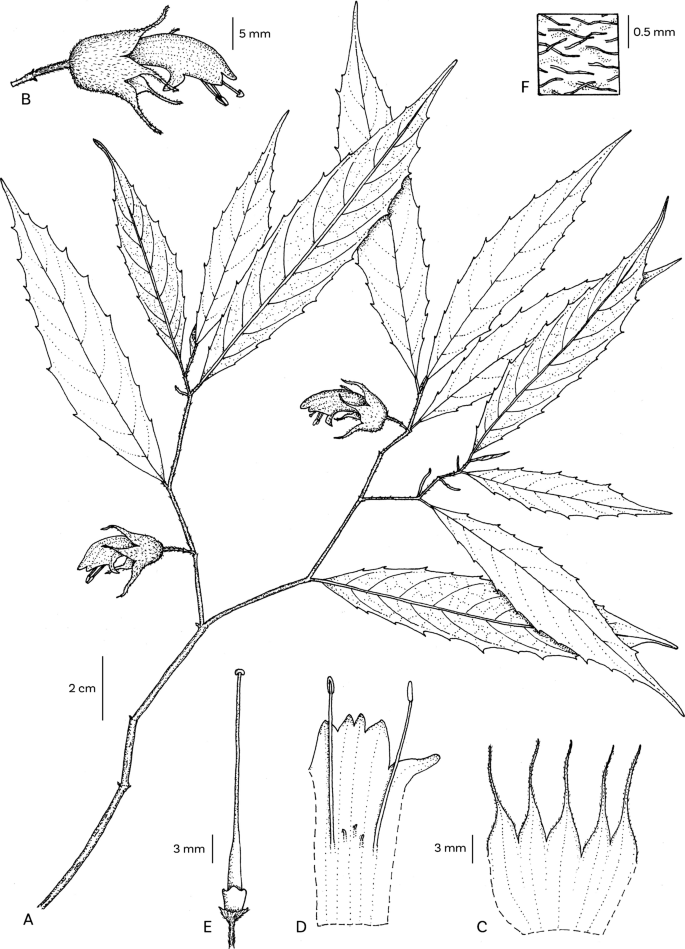
Cyrtandra huonensis. A habit, flowering, leafy stem; B flower showing scale-like bracts; C dissected calyx; D dissected corolla showing two stamens and three staminodes; E gynoecium with disk; F detail of calyx indumentum. All from Hoogland 9241. Drawn by Sebastian A. Hatt.
http://www.ipni.org/urn:lsid:ipni.org:names:77379478-1
Small shrub, 1 – 1.5 m tall. Stems woody towards base, striate, glabrous but very sparsely hairy on young growth. Leaves opposite, those of a pair strongly anisophyllous with minor leaf absent or strongly reduced; petioles of major leaf 2 – 3 (– 4) mm long; blades of major leaf narrowly lanceolate, 8 – 12 × 1.5 – 2.2 cm, apex narrowly acuminate, acumen c. 20 mm long, base cuneate to attenuate; margin with prominent regularly spaced and sized teeth, to 2 mm long; 7 – 9 pairs of lateral veins, tertiary venation reticulate, only faintly visible; adaxial surface dull dark green (when dried), glabrous; abaxial surface dull pale green (when dried), blade mostly glabrous, veins with moderately dense covering of pale hairs. Minor leaf absent or if present, linear, to 6 (– 10) mm long. Inflorescence sessile or on peduncle to 3 mm long, in leaf axils, 1-flowered. Bracts absent or very reduced to scales, 1 × 1 mm, triangular, densely covered in pale hairs. Pedicel 5 – 8 × 0.5 – 0.8 mm, densely covered in pale hairs. Calyx pink, 14 – 22 mm long, hairy externally but more dense at the base; lobes 5, lobes 6 – 12 mm long, very narrowly acuminate to almost linear. Corolla red, sometimes pink towards base, sometimes white inside; tubular, arcuate, held erect, 20 – 25 mm long, lobes in 4+1 configuration, lower lobe recurved, triangular, upper lobes 2 × 2 mm, lateral lobes 2 × 6 – 7 mm, lower lobe 5 × 5 mm; external surface of corolla with dense, short glandular hairs, with a sparser covering towards the base; interior surface of lobes hairy but tube glabrous. Filaments glabrous, 10 – 12 mm long, straight to curved, inserted c. 5 mm up from base of corolla. Anthers c. 1.5 – 2 mm long, sometimes observed cohering at tip, not exserted to exserted 2 – 5 mm beyond corolla; 2 – 3 staminodes present, 2 – 3 mm long. Gynoecium 23 – 26 mm long; ovary glabrous; disk cupular, with undulate margin, c. 3 mm long; style glandular hairy towards apex; stigma discoid, margin densely covered in hair-like projections, surface glabrous. Fruit not seen. Seeds not seen.
recognition. Cyrtandra huonensis S.Hatt & Bramley is most similar to C. asekiensis S.Hatt & Bramley. Both species have a pair of strongly anisophyllous leaves, the major leaf narrowly lanceolate, an inflated calyx. However, C. huonensis can be distinguished by lacking bracts (vs bracts 4 – 8 mm long), calyx lobes very narrowly acuminate to almost linear (vs acuminate from a triangular base) and leaf apex narrowly acuminate (vs acuminate).
distribution. Papua New Guinea. Morobe, southern slopes of Huon Peninsula. See Map 1.
specimens examined. papua new guinea. Morobe: Huon Peninsula, E slope of Mt Rawlinson, along Gang Creek, 4600 ft, 21 June 1964, Hoogland 9241 (A [A02313514], BO [BO1979634], BRI [cited as duplicate on specimen but not found online], CANB [CANB0840413, CANB00840414], E [E00632691, E00632692], K [K001515436], L [L2823349, L2823350], LAE [LAE10864], NY, US [US00737613, US00737614]); Guambat, 3 miles N of Boana, c. 1500 m, 10 Oct. 1986, Argent & Sandham 86/29 (E [E00152599]).
habitat. Collected in submontane and secondary and Castanopsis-oak forest; elev. 1400 – 1500 m.
conservation status. The last known collection of this species was in 1986. There are only two known localities, about 40 km apart, in the mountains north of Lae. The extent of occurrence (EOO) and area of occupancy (AOO) cannot be reliably calculated from just two localities. Both specimens were collected at a similar elevation. Satellite imagery (Google Maps 2025) appears to show that much of the rainforest at one of the localities has already been deforested, while the other appears to be untouched. From this preliminary appraisal, we assess Cyrtandra huonensis as Data Deficient (DD) given the lack of data available, but suggest it is most likely threatened.
etymology. The epithet huonensis is derived from the Huon Peninsula, where the type specimen of this species was collected.
6. Cyrtandra milneensis S.Hatt & Bramley sp. nov. Type: Papua New Guinea. Milne Bay, North slopes of Mt Dayman, Maneau Range, 1350 m, 10 July 1953, Brass 23379 (holotype K [K001515747], isotypes A [A02313374], CANB [CANB127438], L [L2822964], LAE [LAE18158], US [US00081172]). (Fig. 8).
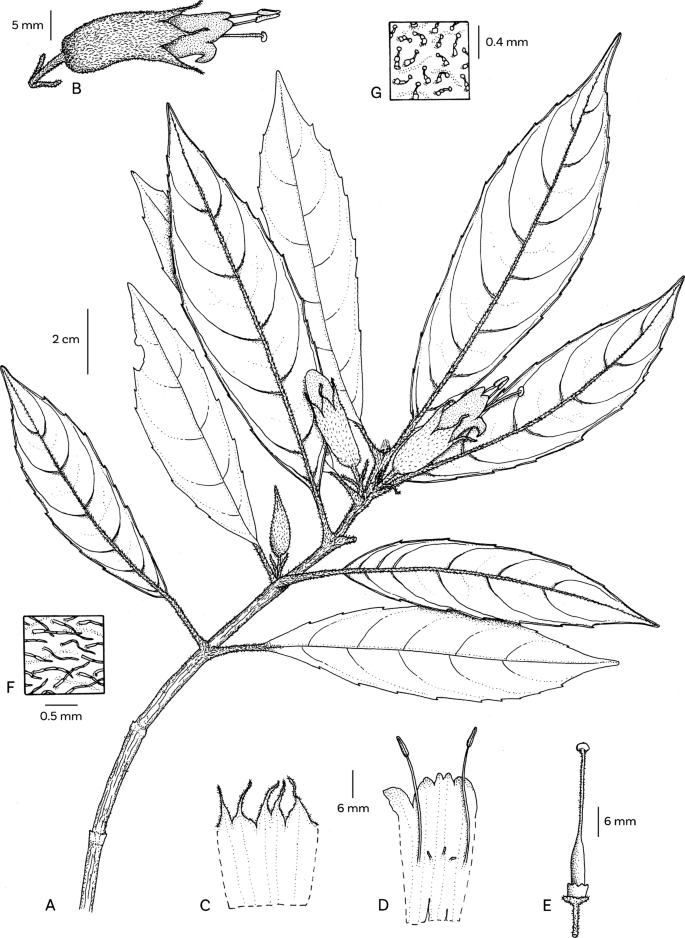
Cyrtandra milneensis. A habit, flowering, leafy stem; B flower with bracts; C dissected calyx; D dissected corolla showing two stamens and three staminodes; E gynoecium with disk; F detail of calyx indumentum; G detail of corolla indumentum. All from Brass 23379. Drawn by Sebastian A. Hatt.
http://www.ipni.org/urn:lsid:ipni.org:names:77379479-1
Small, spreading shrub, 1 – 2 (– 2.5) m tall. Stems woody towards base, striate, sparsely hairy, denser on young growth. Leaves opposite, those of a pair mostly subequal, though apparently readily dehiscing leaves; petioles of major leaf 10 – 15 mm long; blades of major leaf in subequal leaf pairs narrowly elliptic, 9.5 – 17 × 2.5 – 4.5 cm, apex acute to acuminate, base attenuate to attenuate-obtuse, symmetrical, margin faintly, sparsely, shallowly toothed, teeth often irregularly spaced; (4 –) 5 – 6 (– 7) pairs of lateral veins, tertiary venation not visible or extremely faint, adaxial surface of leaves pale dark grey-green, slightly mottled, glabrous, abaxial surface dark tan to dull pale green-tan, with dark-brown multicellular hairs densely covering midrib and lateral veins, but sparsely covering blade. Inflorescence sessile, in leaf axils, 1 – 3-flowered. Bracts linear, 3 – 7 mm long, densely covered with brown hairs. Pedicel dark brown when dry, 5 – 8 mm long, densely covered with brown hairs. Calyx red, 23 – 28 mm long, hairy externally, evenly 5-lobed or upper three slightly closer together than to the lower two, lobes 6 – 8 mm long, narrowly acute to acuminate. Corolla bright red to pinkish-red, sometimes with yellow tip or stripes, slightly funnel-shaped, slightly arcuate, held erect, 30 – 34 mm long, lobes in 4+1 configuration, lower lobe strongly recurved, triangular, upper lobes 2 – 3 × c. 2 mm, lateral lobes 2 – 3 × 2 – 4 mm, lower lobe c. 5 mm long; external surface of corolla with dense short glandular hairs, with a sparser covering towards the base; interior surface of lobes hairy but tube glabrous. Filaments glabrous except sparsely glandular hairy towards apex, c. 25 mm long, white, straight, inserted c. 12 mm up from base of corolla. Anthers c. 3 mm long, not observed cohering at tip, exserted to 10 mm beyond corolla. Gynoecium 32 – 36 mm long; style not exserted to exserted to 3.2 mm beyond corolla; ovary glabrous; disc cupular, with slightly undulate margin, 2.5 mm long; style glandular hairy in upper half, getting more dense towards apex; stigma discoid, glabrous. Fruit green when fresh, not seen on specimens. Seeds not seen.
recognition. Cyrtandra milneensis S.Hatt & Bramley is most similar to C. terrae-guilelmi K.Schum. Both species have a large calyx. However, C. milneensis can be distinguished by its mostly subequal leaf pairs (vs leaf pairs strongly anisophyllous), larger calyx at 23 – 28 mm long (vs 10 – 21 mm long), its larger corolla at 30 – 34 mm long (vs 14 – 26 mm long).
distribution. Papua New Guinea: Milne Bay, in the vicinity of the Mt Suckling complex. See Map 1.
specimens examined. papua new guinea. Milne Bay: North slopes of Mt Dayman, Maneau Range, 1250 m, 22 June 1953, Brass 22999 (A [A02313468], CANB [CANB120144], K [K001515629], L [L2823366], LAE [LAE18169], US [US00081171]); North slopes of Mt Dayman, Maneau Range, 1350 m, 10 July 1953, Brass 23379 (A [A02313374], CANB [CANB127438], K [K001515747], L [L2822964], LAE [LAE18158], US [US00081172]); Nepesip, 1280 m, 4 Nov. 1956, Cruttwell 852 (K [K001515631]); Mt Duau, 1524 m, 8 Sept. 1959, Cruttwell 1111 (K [K001515630]); Buat to Nepesip, Kwarune above Maup Waterfall on R. Iao, 1460 m, 10 July 1968, Woods 2237 (A [A02313012], B [B100056094], BO [BO0008594], E [E00632631, the specimen with the barcode E00632526 has the same label but is not the same plant], K [K001515720], LAE [LAE259672]); Near Ma-u R., M.I. Road to Mt Suckling, 1067 m, 17 June 1972, Katik NGF 46995 (A [A02312981], BO, BRI [BRI AQ0353285], CANB [CANB00518521], E [E00632418], K [K001515691], L [L2823514]); Junction Ugat and Mayu Rs, near Mayu I, 1100 m, 15 July 1972, Streimann & Katik NGF 28913 (A [A02313413], BRI [BRI AQ0353266], CANB [CANB00515613], E [E00632614], K [K001515746], L [L2823511], LAE [LAE151137]); Mt Paori, above Mayu I, c. 1000 m, 18 July 1972, Streimann NGF 28948 (A [A02313412], BO [BO1981959], BRI [BRI AQ0353265], CANB [CANB00515612], E [E00632615], K [K00151675], L [L2823512], LAE [LAE151130]).
habitat. Undergrowth of forest, often Castanopsis-dominated; elev. 1000 – 1530 m.
conservation status. The last known collection of this species was in 1972. The extent of occurrence (EOO) is 605 km2 and area of occupancy (AOO) is 20 km2. There are four known locations. Satellite imagery (Google Maps 2025) suggests that most of the forest in this area remains undisturbed, apart from the valleys around Nepesip, which have been heavily deforested for smallholder farming. From this preliminary appraisal, we assess Cyrtandra milneensis as Endangered (EN) under criteria B1ab(iii)+2ab(iii).
etymology. The epithet milneensis is derived from the Milne Bay, the province of Papua New Guinea in which all known specimens have been found.
7. Cyrtandra terrae-guilelmi K. Schum. (Schumann 1887: 217); Schlechter (1923: 351); Gillet (1975: 398); Clark et al. (2013: 179); Bramley et al. (2024: 19). Type: Papua New Guinea. Morobe, Sattelberg bei Finschafen, July 1886, Hollrung 203 (lectotype, designated in Bramley et al. (2024: 19): WRSL (photo at K); isolectotypes photo at E [E00062671], K [K000831726, K000831727, K001515812]). (Fig. 9).
Cyrtandra schumanniana Schltr. (Schlechter 1923: 352); Bramley et al. (2024: 18). Type: Papua New Guinea. Morobe, In den Wäldern des Kani-Gebirges, 500 – 1000 m, 3 Oct. 1907, Schlechter 16628 (lectotype, designated by Bramley et al. (2024: 18): LY [LY0474285]; isolectotypes: BO, LY [LY0474286, LY0772984, LY0772985, LY0772986, LY0772987, LY0772988, LY0772989, LY0772990]).

Cyrtandra terrae-guilelmi. Examplary specimen (Hartley TGH 10533; A02312908). © Harvard Herbarium. The enlarged flower is from the type specimen (Hollrung 203). © Kew Herbarium.
Small, erect shrub, 0.5 – 2.5 m tall. Stems woody towards base, striate, glabrous but hairy on young growth. Leaves opposite, those of a pair strongly anisophyllous with minor leaf absent or strongly reduced; petioles of major leaf 3 – 14 (– 20) mm long; blades of major leaf elliptic to lanceolate to broadly oblanceolate, (5 –) 8 – 22 (– 27) × (2 –) 3 – 6 (– 8) cm, apex acuminate, acumen to 15 mm long, base cuneate to rounded-cuneate; margin with irregularly to regularly spaced teeth, shallow to prominent; (5 –) 7 – 8 (– 12) pairs of lateral veins, tertiary venation reticulate, prominent or rarely faintly visible; adaxial surface dull dark green, glabrous on older leaves, pubescent on young leaves, rarely bullate; abaxial surface pale green, blade mostly glabrous, veins with hairs. Minor leaf absent or if present, linear-subulate or linear with triangular base, 4 – 20 mm long. Inflorescence sessile or on peduncle to 2 mm, in leaf axils, 1 – 2- (– 3)-flowered. Bracts 2 (– 6), linear-subulate, (4 –) 7 – 10 (– 17) mm long, densely covered in hairs. Pedicel (4 –) 7 – 10 mm long, densely covered in hairs. Calyx red, rarely pink, 10 – 21 mm long, hairy externally, glabrous internally; lobes 5, unequal; lobes 4 – 9 mm long, acuminate to narrowly acuminate. Corolla red, sometimes yellow at mouth; tubular, straight to slightly arcuate, held erect, 14 – 26 mm long, lobes in 4+1 configuration, lower lobe recurved, triangular, upper lobes 1.5 – 2 × 1.5 – 2 mm, lateral lobes 2 – 3 × 4 – 6 mm, lower lobe 5 – 6 (– 9) mm long; external surface of corolla with dense, short bulbous-based hairs, with a sparser covering towards the base; interior surface of lobes hairy but tube glabrous. Filaments white, glabrous or rarely very sparsely covered with hairs, (12 –) 20 – 23 mm long, curved, inserted c. 6 mm up from base of corolla. Anthers white, 2 – 3 mm long, sometimes observed cohering at tip, not exserted to exserted; staminodes 3, 0.5 – 1 (– 3) mm long. Gynoecium (14 –) 25 – 32 mm long; ovary glabrous; disc cupular, with undulate entire margin, c. 1 mm long; style densely covered in bulbous-based hairs towards apex; stigma white, discoid, margin often with short hair-like projections, surface glabrous. Fruit white, ovoid to ovoid-acuminate, 14 – 16 mm long, including persistent style base. Seeds many, c. 0.3 mm long, ovoid.
recognition. See Cyrtandra buloloensis S.Hatt & Bramley and C. milneensis S.Hatt & Bramley for similarities.
distribution. Papua New Guinea. Morobe, New Britain. See Map 1.
specimens examined. papua new guinea. Morobe: Sattelberg bei Finschafen, July 1886, Hollrung 203 (photo at E [E00062671], K [K000831726, K000831727, K001515812], WRSL); Kekagallu, Sattelberg, 970 m, 22 – 26 July 1890, Lauterbach 546 (E [E00259940], K [K001515335], L [L2823333], WRSL); Kaiser Wilhelms Land: Sattelberg, 800 m, June 1899, Nyman 415 (C [NHMD923017]); In Wäldern bei Umbili, 400 m, 7 Aug. 1907, Schlechter 16385 (BO, LY [LY0474283, LY0474284], P [P03884377]); In den Wäldern des Kani-Gebirges, 500 – 1000 m, 3 Oct. 1907, Schlechter 16628 (BO, LY [LY0474285, LY0474286, LY0772984, LY0772985, LY0772986, LY0772987, LY0772988, LY0772989, LY0772990], P [P03884376]); Busch in den Wäldern des Kani Gebirges, 500 m, 3 Oct. 1907, Schlechter 16629 (LY [LY0474282]); Kaui Gebirge, 1000 m, 21 March 1908, Schlechter 17492 (C [NHMD923015]); K [K000734953], L [L0003198]); In den Wäldern des Kaui Geb., 1000 m, 25 May 1908, Schlechter 17773 (E [E00632688], K [K001515681]); In den Wäldern des Bismarck-Gebirges, 2000 m, Nov. 1908, Schlechter 18829 (LY [LY0474281]); Vicinity of Kajabit Mission, 800 – 2000 ft, Aug. – Dec. 1939, Clemens 40811 (A [A02313198]); Boana, 2500 – 4500 ft, May – Nov. 1940, Clemens 41304 (A [A02313199]); Trans-Busu Rimber Lease near Lae, 17 June 1954, Hoogland & Floyd 5762 (A [A02313389], CANB [CANB59746], K [K001515752], L [L2823253], LAE [LAE17913]); Kaindi, 2060 m, 25 May 1959, Brass 29768 (A [A02313185], CANB [CANB101963], K [K001515425], L [L2823206], LAE [LAE36946], US [US00081134]); Aztera Range, near Lae, 13 Aug. 1959, Henty NGF 11531 (A [A02313372], BO [BO1730281], BRI [BRI AQ0221730], K [K000734954], L [L2823194], LAE [LAE30033], SING [SING0200971]); Vicinity Kikiepa village near Wantoat Patrol Post, southern slopes of Finisterre Mts, c. 5000 ft, 1 June 1960, Womersley & Thorne NGF 12614 (CANB [CANB100494], K [K000734955], L [L2822859], US [US00081176]); Foothills of Aztera Range, 5 miles from Lae, c. 250 ft, 1 June 1961, Womersley NGF 13427 (A [A02313417], BRI [cited as duplicate on specimen but not found online], CANB [CANB99684], K [K001515730], L [L2822863], LAE [LAE35434]); Busu R., 200 ft, 16 Oct. 1961, Henty NGF 14346 (A [A02313255], BRI [BRI AQ0221579], CANB [CANB114056], K [K001515732], L [L2823613], LAE [LAE35800]); 6 miles from Lae, 16 Nov. 1961, Millar NGF 13859 (A [A02313045], BRI [BRI AQ0221575], CANB [CANB113306], LAE [LAE37462]); Oomsis Creek, about 18 m W of Lae, 1000 ft, 20 July 1962, Hartley TGH 10533 (A [A02312908], BRI [BRI AQ0221870], CANB [CANB142018], K [K000734956], L [L2826322, L2826323], LAE [LAE61102]); Bumaiyum Creek, Buimo, 23 Aug. 1963, Millar NGF 15889 (K [K001515625], LAE [LAE61678]); Bumaiyum Creek, Buimo, 23 Aug. 1963, Millar & van Royen NGF 15895 (BRI [BRI AQ0221594], CANB [CANB153351], K [K001515624], L [L2823051], LAE [LAE61833]); Bumaiyum Creek, Buimo, 9 Nov. 1963, Millar NGF 18821 (A [A02312982], BRI [BRI AQ0221566], CANB [CANB192575], E [E00632693], L [L2822869], LAE [LAE94436]); Bugai-au village, 4000 ft, 6 Jan. 1965, Sayers NGF 21543 (BM); Ridge SE of Bouwao, SW of Lae, 1500 m, 8 Jan. 1965, Jermy 4673 (E [E00632482]); Edie Creek, 6500 ft, 24 April 1965, Womersley NGF 19496 (BO [BO1733001], BRI [BRI AQ0221580], CANB [CANB164818], LAE [LAE74761]); Gahari, 50 ft, 30 Oct. 1966, Millar NGF 22750 (BRI [BRI AQ0221641], CANB [CANB178962], E [E00632417], L [L2822895], LAE [LAE86171]); Bulldog road, Edie Creek, 6500 ft, 3 Nov. 1966, Ridsdale NGF 30203 (LAE [LAE103841]); Huon Peninsula, Rawlinson Mts, near Aregenag village, c. 1000 m, 19 June 1968, Woods 1918 (BO [BO0008760], E [E00632584], L [L2823231, 2823232], LAE [LAE259680]); Busu Creek area, along Sankwep R., c. 10 m N of Lae, 1000 ft, 4 Sept. 1968, Webster & Hildreth 15066 (CANB [CANB327040]); Sankwep Logging Road, 20 m from Lae, 200 m, 26 June 1972, Womersley LAE 55252 (A [A02313167], BISH, BRI [cited as duplicate on specimen but not found online], CANB [CANB00518131], E [E00632591], K [K001515701], L [L2823479, L2823480], SYD); Boana, 900 m, 19 Feb. 1977, Conn et al. 50 (A [A02313278], BFC, CANB [CANB517628], K [K001515651], L [L2823498], LAE [LAE232089]); Bumayong, 200 m, 13 Oct. 1990, Takeuchi 6957 (BO [BO1944240], E [E00632729, E00632730], K [K000938992, K000939044], L [L3794441], US [US01246643]); Mt Kolorong Wildlife Conservation Area, Kuper Range, 2050 m, 13 May 1993, Höft 3628 (L [L2826320]); Aztera Range, inland from the 9 mile settlement, 200 – 400 m, 1 Dec. 1993, Takeuchi 9287 (A [A02313250], CANB [CANB00528158], E [E00678929], MO [MO3518533]); Mt Kolorong Wildlife Conservation Area, Kuper Range, 2020 m, 16 Dec. 1993, Höft 3824 (BRIT [BRIT620690, BRIT620691], L [L2826318]); Aztera Range near Bubia, 70 m, 9 June 2001, Takeuchi & Ama 15330 (A [A02312906], BRIT [BRIT620689], E [E01137312], L [L3805859], LAE [LAE277927]); Bulolo, near Mt Kaindi, Harmony mine road, Amata Junction, 2300 m, 7 Nov. 2006, de Kok 1268 (K [K000611865], LAE [LAE287940]); Siboma, Sayama, track along the ridgeline S from Camp 1, 600 m, 13 June 2012, James SAJ0809 (BISH [BISH1002544], US). Eastern Madang: Below the village of Budemu, southern slopes of the Finisterre Range, c. 3550 ft, 22 Oct. 1964, Pullen 6017 (A [A02313410], BM, BRI [cited as duplicate on specimen but not found online], CANB [CANB155005, CANB155006], E [E00632702, E00632703], G, K [K001515481], L [L2823058], LAE [LAE287940], US [US00738239]). New Britain: Lairu Creek, near Gule, Cape Hoskins, West Nakanai, 23 Aug. 1954, Floyd 6596 (A [A02313369], BISH [BISH745644], BO [BO1981210], CANB [CANB59750], K [K000734965], LAE [LAE287940], US [US00081180]); Near Urin, 50 ft, 4 May 1958, White NGF 10002 (A [A02312920], BO [BO1730278], BRI [BRI AQ0221851], K [K000734967], L [L2826777], LAE [LAE287940]); Near Ourea village, near Kandrian, 1300 ft, 29 July 1965, Buderus NGF 23929 (BO [BO1979731], BRI [BRI AQ0221564], BISH, CANB [CANB183248], K [K001515618], L [L2826778], LAE [LAE287940], NSW, PNH, SING, UH, US [US00081122]); Mt Tangis, NE slopes of Airagilpua, 17 Nov. 1965, Frodin NGF 26293 (LAE [LAE287940]); Pulie R., about 10 miles from mouth, W side, Kandrian, 100 ft, 14 March 1966, Henty NGF 27187 (A [A02313438], BRI [BRI AQ0221585], CANB, K [K001515617], L [L2826779], LAE [LAE287940]); Hoskins, Salae area, c. 100 ft., 21 Dec. 1967, Coode & Lake NGF 32640 (CANB [CANB185163], K [K000734965], L [L2826781], LAE [LAE96800]); Rabaul, Lackit, 2500 ft, 1 April 1968, Ridsdale & Katik NGF 38017 (A [A02313124], BRI [cited as duplicate on specimen but not found online], CANB, K [K001515643], L [L2826782], LAE [LAE100784]); Talasea, several miles SW of Rikau village, 9 April 1959, White NGF 10494 (A [A02312921], CANB [CANB77735, CANB77734], K [K000734966], L [L2822921]); Kokopo, Head of Valilie R., Trans Vudal, 400 ft, 14 Aug. 1969, Streimann NGF 44375 (A [A02313411], BRI [cited as duplicate on specimen but not found online], K [K000734957], L [L2826775], LAE [LAE113450]); Between Avungi village and Mt Lakit, 600 m, 3 June 1973, Croft & Katik NGF 41445 (BRI [BRI AQ0353233], CANB [CANB00517950], K [K001515801], L [L2823694], LAE [LAE206846], M, SYD); SE slopes of The Father (Mt Ulawun), 210 m, 5 June 1973, Stevens & Lelean LAE 58559 (BISH [BISH401125], LAE [LAE205198]); Near main logging road above Bialla, 120 – 460 m, 3 July 1973, Gillett 2554 (A [A02312922], BRI [cited as duplicate on specimen but not found online], K [K000734968], L [L2826776], LAE [LAE217160], UC); Gorge below Yau Yau Village, 20 km SE of Salelubu, in Nakanai Range, along the Waisalau-Yau Yau track, 700 m, 5 July 1973, Gillett 2557 (K [K000734969], LAE [LAE217161], UC); Whiteman Range; near Balus; Mogou, by Kiparui R., near camp site, 400 m, 2 Aug. 2011, James SAJ0135 (BISH [BISH1002416]). New Ireland: Without further locality, 1876, Brown s.n. (MEL [cited by Gillett (1975) but not found online]).
habitat. Lowland to upper montane forest, elev. 0 – 2300 m.
conservation status. The last known collection of this species was from 2011. The extent of occurrence (EOO) is 114,290 km2 and area of occupancy (AOO) is 144 km2. This species appears to be widespread across the entire length of New Britain, and has been collected at numerous points around Morobe province, particularly within 50 km of Lae. Some populations are likely to be threatened or extinct, as satellite imagery (Google Maps 2025) reveals deforestation of large areas of rainforest across Morobe province. From this preliminary appraisal, we assess Cyrtandra terrae-guilelmi as Least Concern (LC).
etymology. The epithet terrae-guilelmi is derived from the latin for ‘Kaiser Wilhelmsland’, the name for German New Guinea from 1871 to 1920. The type specimen was collected during this period.
notes. Schlechter described Cyrtandra schumanniana as distinct from C. terrae-guilelmi based on the style being of equivalent length to the corolla (vs considerably exserted). Given this character varies considerably depending on the developmental stage of the flower and is not informative of species relationships, we synonymise C. schumanniana here.
Although geographically separated, the populations of Cyrtandra terrae-guilelmi on New Britain appear to be morphologically indistinguishable from those on the mainland, with the exception of slightly thinner, more papery leaves.
This species grows across a large elevational range, from sea level to c. 2300 m. Higher altitude collections tend to have considerably smaller, more bullate leaves and slightly smaller flowers, although these characters vary gradually along the elevational gradient.
There is a single record from New Ireland: Brown s.n. (MEL), that is mentioned in Gillett (1975), but this specimen has not been seen by the authors. No further specimens of Cyrtandra terrae-guilelmi have yet been found from New Ireland.
8. Cyrtandra wilhelmensis P. Royen (1983: 2955); Bramley et al. (2024: 20). Type: Papua New Guinea. Eastern Highlands, Mt Wilhelm, E slopes, 2650 m, 17 July 1959, Brass 30579 (holotype CANB [CANB101813]; isotypes K [K000831734], L [L0003210], LAE, US [US00081156]). (Fig. 10).
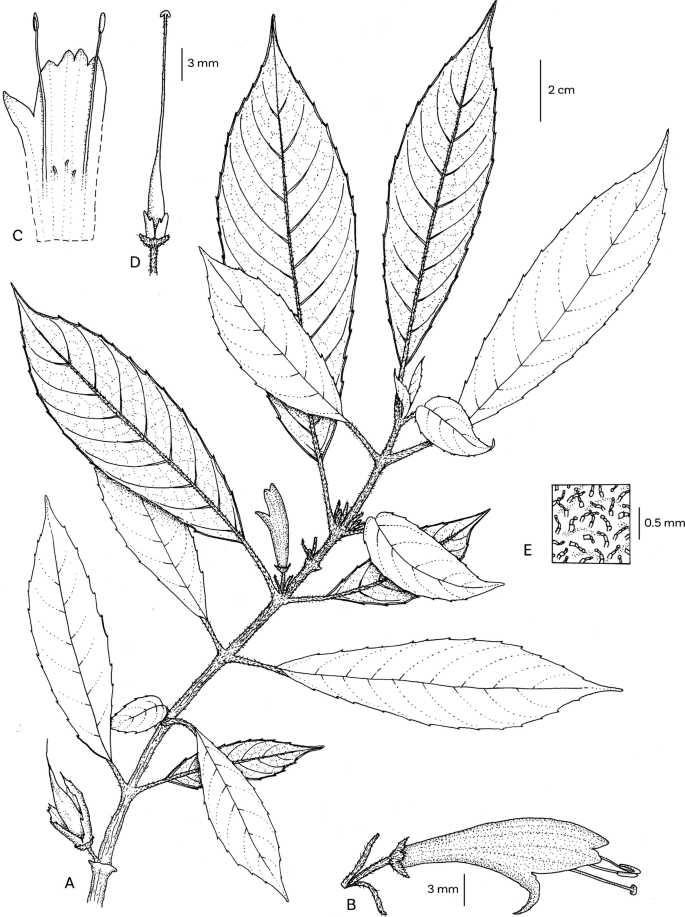
Cyrtandra wilhelmensis. A habit, flowering, leafy stem; B flower with bracts; C dissected corolla showing two stamens and three staminodes; D gynoecium with disk; E detail of corolla indumentum. All from Hoogland 9547. Drawn by Sebastian A. Hatt.
Small, erect shrub, 1.2 – 2.5 m tall. Stems woody towards base, striate, glabrous on older stems, hairy on younger growth. Leaves opposite, anisophylly variable with minor leaf in subequal leaf pairs typically ¼ to full size of major leaf; petioles of major leaf 8 – 25 mm long; blades of major leaf in leaf pair oblanceolate to elliptic-oblanceolate, 6 – 15 × 2 – 4.5 cm, apex shortly acuminate, base cuneate-attenuate, symmetrical; margin faintly, shallowly toothed, often irregularly spaced; 5 – 7 pairs of lateral veins, tertiary venation prominent; adaxial surface dull dark green, glabrous; abaxial surface light dull tan, blade sparsely covered in hair, veins moderately densely covered in hair. Minor leaf absent or like major but smaller and reduced. Inflorescence sessile, in leaf axils, 1 (– 2)-flowered. Bracts linear, 5 – 9 mm long, densely covered with rusty brown hairs. Pedicel 2 – 7 (– 9) mm long, densely covered with rusty brown hairs. Calyx very reduced and readily dehiscent so usually not visible on flowers, if present then cupular with an irregular margin, usually longer on one side; densely covered in rusty brown hairs. Corolla pale or dull red, sometimes with pale yellow base, or less commonly entirely yellow or cream; tubular, slightly arcuate to straight, held erect, 19 – 25 mm long, lobes in 4+1 configuration, lower lobe strongly recurved, triangular, upper lobes 1 – 2 × 1 – 2 mm, lateral lobes 1 – 2 × 6 – 7 mm, lower lobe 3 – 5 × 3 – 5 mm; external surface of corolla with dense short glandular hairs with a sparser covering towards the base; interior surface of lobes with the same hairs but tube glabrous. Filaments glabrous, c. 22 mm long, inserted c. 6 mm up from base of corolla. Anthers 2 mm long, not observed cohering at tip, not exserted to exserted to 5 – 10 mm beyond corolla. Gynoecium exserted beyond corolla to 5 – 10 mm; ovary glabrous; disc unilateral, margin very deeply lobed, 1 – 2 mm long; style glandular hairy towards apex; stigma discoid, glabrous. Fruit green, glabrous, ovoid, shortly acuminate, 17 – 25 × 5 – 6 mm, corolla persistent but split. Seeds many, small.
recognition. Cyrtandra wilhelmensis P.Royen is most similar to C. ferruginicalyx S.Hatt & Bramley. Both species have leaves with variable anisophylly and a unilateral nectary disc. However C. wilhelmensis can be distinguished by its lack of calyx (vs calyx clearly present), its oblanceolate to elliptic-oblanceolate leaves (vs lanceolate to broadly lanceolate), and by being a terrestrial, erect shrub 1.2 – 2.5 m tall (vs terrestrial or epiphytic shrub 0.45 – 1.5 (– 2) m tall).
distribution. Papua New Guinea. Scattered across the montane forests of the Bismarck Range from around Mt Wilhelm westwards to Wabag, and across the Finisterre Range. See Map 1.
specimens examined. papua new guinea. Eastern Highlands: Mt Wilhelm, E slopes, 2650 m, 17 July 1959, Brass 30579 (CANB [CANB101813], K [K000831734], L [L0003210], LAE, US [US00081156]); Chimbu subdistr., Keglsugl, 2600 m, 27 Aug. 1964, Millar & Sayers NGF 23803 (BRI [BRI AQ0221582], CANB [CANB166109], E [E00632684], L [L2822949], LAE [LAE79263]). Madang: Dindongo [Dindinogoi?], c. 2700 m, 14 Oct. 1966, Borgmann 263 (B [B101149241]); Schrader Range, Kaironk Valley, c. 2200 m, 5 Dec. 1999, Gardner 9927 (AK [AK340922], CANB [CANB00827138], K [K000939609]); Walking track to Siwa Siwa, c. 300 m N of Siwa Siwa Camp, c. 500 m N of junction with walking track to Madang, c. 2.5 km N of Teptep, 27 Sept. 2010, Conn 5407 (BISH [BISH1002147], LAE [LAE295603], NSW [NSW870070]). Morobe: Sambanga, 1524 – 1820 m, 1937, Clemens 6729 (B [B101149223]); Masak R., above Sambanga, 1820 – 2130 m, 9 Dec. 1937, Clemens 7886 (B [B101149219]); Mannasat, Cromwell Mts, Huon Peninsula, c. 2350 m, 11 Aug. 1964, Hoogland 9546 (A [A02313516], BRI [cited as duplicate on specimen but not found online], BO [BO1979635], CANB [CANB148796, CANB148797], E [E00632434], K [K001515709], L [L2823053], LAE [LAE75746], US [US00737617]); Mannasat, Cromwell Mts, Huon Peninsula, c. 2300 m, 11 Aug. 1964, Hoogland 9547 (A [A02313515], E [E00632435], CANB [CANB148794, CANB148795], K [K001515707], L [L2823071, L2823072], LAE [LAE75739], US [US00737618]); Kabwum Distr., Mt Wasaunon TKCP project area, 2768 m, 15 July 2004, Fazang 79027 (LAE [LAE284909]); Kabwum Distr., 10 km away from Worin village, Mt Wasaunon, 2768 m, 15 July 2004, Fazang & Jensen 79060 (LAE [LAE287986]). Western Highlands: Hagen subdistr., across gorge of Nebelyer R., opposite Tomba, 2500 m, 24 June 1957, Robbins 15 (CANB [CANB42709]); Wabag subdistr., middle Tale Valley, near Poio village, 2100 m, 25 June 1960, Hoogland & Schodde 6759 (A [A02313223], CANB [CANB83093], L [L2823212], LAE [LAE43137]).
habitat. Montane forest; elev. (1500 –) 1800 – 2600 m.
conservation status. The last known collection of this species was in 2010. The extent of occurrence (EOO) is 21,850 km2 and area of occupancy (AOO) is 40 km2. Known collections are scattered over several mountain ranges, with considerable gaps between each collection. Satellite imagery (Google Maps 2025) suggests that while much of the land in between has been developed and disturbed, there is a considerable matrix of mountainous forests in between where this species also likely occurs. However, imagery at known localities reveals continuing destruction of habitat. From this preliminary appraisal, we assess Cyrtandra wilhelmensis as Near Threatened (NT), as the EOO is approaching the threshold for Vulnerable (20,000 km2), the AOO is under the threshold for Endangered (< 500 km2) and continuing habitat decline is widespread across its range.
etymology. The epithet wilhelmensis refers to Mt Wilhelm, the type locality.
notes. The type specimen of this species does not match the description, illustration and other specimens cited by van Royen in the protologue. Instead, they depict a plant with a fully-formed calyx with narrowly acuminate lobes, and a white to cream corolla in 2+3 configuration. These specimens erroneously cited by van Royen therefore need a name and will be described in a future study. To help resolve confusion around the identity of Cyrtandra wilhelmensis, an illustration is provided here (Fig. 10).
Although most collections of this species report red flowers, two specimens (Hoogland 9546; Clemens 6729) report ‘yellow’ and ‘cream’ flowers respectively. In another specimen (Hoogland 9547), the flower is reported as ‘pale red on pale yellow base’. The only other species in this complex known to produce flowers without corolla in a colour other than red or pink is Cyrtandra asekiensis.
References
Atkins, H. J., Bramley, G. L. C. & Clark, J. R. (2013). Current Knowledge and Future Directions in the Taxonomy of Cyrtandra (Gesneriaceae), with a New Estimate of Species Number. Selbyana 31: 157 – 165. https://www.jstor.org/stable/24894287
____, ____, Nishii, K., Möller, M., Olivar, J. E. C., Kartonegoro, A. & Hughes, M. (2021). Sectional polyphyly and morphological homoplasy in Southeast Asian Cyrtandra (Gesneriaceae): consequences for the taxonomy of a mega-diverse genus. Pl. Syst. Evol 307: 60. https://doi.org/10.1007/s00606-021-01784-x
____ & Kartonegoro, A. (2021). A taxonomic revision of Cyrtandra (Gesneriaceae) in Sulawesi, Indonesia. Edinburgh J. Bot. 78: 1 – 122. https://doi.org/10.24823/EJB.2021.364
Bachman, S., Moat, J., Hill, A. W., Torre, J. de la & Scott, B. (2011). Supporting Red List threat assessments with GeoCAT: geospatial conservation assessment tool. ZooKeys 150: 117 – 126. https://doi.org/10.3897/zookeys.150.2109
Beentje, H. J. (2016). The Kew plant glossary: an illustrated dictionary of plant terms, 2nd ed. Kew publishing, Richmond.
Bramley, G. L. C., Atkins, H. J., Kartonegoro, A. & Jimbo, T (2024). An Annotated Checklist of Cyrtandra, Cyrtandropsis and Sepikea (Gesneriaceae) in New Guinea. Kew Bull. 79: 3 – 31. https://doi.org/10.1007/s12225-023-10151-7
Cámara-Leret, R., Frodin, D. G., Adema, F. et al. (2020). New Guinea has the world’s richest island flora. Nature 584: 579 – 583. https://doi.org/10.1038/s41586-020-2549-5
Clark, J. R., Atkins, H. J., Bramley, G. L. C., Jolles, D. D., Roalson, E. H. & Wagner, W. L. (2013). Towards a phylogenetically informed taxonomy of Cyrtandra (Gesneriaceae) in the Solomon Islands. Selbyana 31: 166 – 183. https://www.jstor.org/stable/24894288
ESRI (2023). ArcGIS Pro. https://www.esri.com/en-us/arcgis/products/arcgis-pro/overview
Gillett, G. W. (1975). Cyrtandra (Gesneriaceae) in the Bismarck Archipelago and Solomon Islands. Kew Bull. 30: 371 – 412. https://doi.org/10.2307/4103165
Google Maps (2025). Satellite imagery of Papua New Guinea. https://www.google.co.uk/maps/ [Retrieved May 2025].
IUCN (2024). The IUCN Red List of Threatened Species. Version 2024-2. https://www.iucnredlist.org/resources/redlistguidelines. [Accessed 20 Dec. 2024].
Kanehira, R. & Hatusima, S. (1943). The Kanehira- Hatusima 1940 Collection of New Guinea Plants. XVIII. Bot. Mag. (Tokyo) 57: 111 – 131. https://doi.org/10.15281/jplantres1887.57.111
Lauterbach, K. (1910). Gesneriaceae. In: Nova Guinea. Résultats de l’expedition scientifique néerlandaise a la Nouvelle Guinée. Vol. 8, part 1: 325 – 332. E. K. Brill, Leiden. https://www.biodiversitylibrary.org/item/42443#page/347/mode/1up
____ (1912). Gesneriaceae. In: Nova Guinea. Résultats de l’expedition scientifique néerlandaise a la Nouvelle Guinée. Vol. 8, part 2: 859 – 862. E. K. Brill, Leiden. https://www.biodiversitylibrary.org/item/42447#page/261/mode/1up
Lucas, E. J., Amorim, B. S., Lima, D. F., Lima-Lourenço, A. R., Lughadha, E. M. Nic, Proença, C. E. B., Rosa, P. O., Rosário, A. S., Santos, L. L., Santos, M. F., Souza, M. C., Staggemeier, V. G., Vasconcelos, T. N. C. & Sobral, M. (2018). A new infra-generic classification of the species-rich Neotropical genus Myrcia s.l. Kew Bull. 73: 9. https://doi.org/10.1007/s12225-017-9730-5
McDade, L. A. (1995). Species Concepts and Problems in Practice: Insight from Botanical Monographs. Syst. Bot. 20: 606 – 622. https://doi.org/10.2307/2419813
Middleton, D. J., Armstrong, K., Baba, Y., Balslev, H., Chayamarit, K., Chung, R. C. K., Conn, B. J., Fernando, E. S., Fujikawa, K., Kiew, R., Luu, H. T., Aung, M. M., Newman, M. F., Tagane, S., Tanaka, N., Thomas, D. C., Tran, T. B., Utteridge, T. M. A., Welzen, P. C. van, Widyatmoko, D., Yahara, T. & Wong, K. M. (2019). Progress on Southeast Asia’s Flora projects. Gard. Bull. Singapore 71: 267 – 319. https://doi.org/10.26492/gbs71(2).2019-02
Moore, S. (1916). Gesneraceae. In: H. N. Ridley et al., Report on the Botany of the Wollaston Expedition to Dutch New Guinea. Trans Linn. Soc. London, Bot., ser. 2, Vol. 9: 122 – 132. https://www.biodiversitylibrary.org/page/3421047#page/132/mode/1up
Muñoz‐Rodríguez, P., Wood, J. R. I., Wells, T., Carruthers, T., Sumadijaya, A. & Scotland, R. W. (2023). The challenges of classifying big genera such as Ipomoea. Taxon 72: 1201 – 1215. https://doi.org/10.1002/tax.12887
Royen, P. van. (1983). Alpine Flora of New Guinea, Vol. 4. J. Cramer, Vaduz.
Schlechter, R. (1923). Gesneriaceae Papuanae. Bot. Jahrb. Syst. 58: 255 – 379. https://www.biodiversitylibrary.org/item/268458#page/275/mode/1up
Schumann, K. (1887). Gesneraceae. In: Die Flora der deutschen ost-asiatischen Schutzgebiete. Bot. Jahrb. Syst. 9 (2): 217 – 218. https://www.biodiversitylibrary.org/item/137443#page/237/mode/1up
____ (1905). Gesneraceae. In: Nachträge zur Flora der deutschen Schutzgebiete in der Südsee pp 373 – 385. Gebrüder Borntraeger, Leipzig. https://www.biodiversitylibrary.org/item/14420#page/371/mode/1up
SYZWG [Syzygium Working Group] (2016). Syzygium (Myrtaceae): Monographing a taxonomic giant via 22 coordinated regional revisions. PeerJ Preprints 4: e1930v1. https://peerj.com/preprints/1930/
Thiers, B. M. (2024, updated continuously). Index Herbariorum. https://sweetgum.nybg.org/science/ih/
Wagner, W. L., Wagner, A. J. & Lorence, D. H. (2013). Revision of Cyrtandra (Gesneriaceae) in the Marquesas Islands. Phytokeys 30: 33 – 64. https://doi.org/10.3897/phytokeys.30.6147
Index of exsiccatae
Argent & Sandham 86/29 (C. huonensis).
Borgmann 263 (C. wilhelmensis); Brass 22999 (C. milneensis), 23379 (C. milneensis), 29768 (C. terrae-guilelmi), 31055 (C. ferruginicalyx); Brown s.n. (C. terrae-guilelmi); Buderus NGF 23929 (C. terrae-guilelmi).
Clemens 6729 (C. wilhelmensis), 7886 (C. wilhelmensis), 40811 (C. terrae-guilelmi), 41304 (C. terrae-guilelmi); Conn 5407 (C. wilhelmensis); Conn et al. 50 (C. terrae-guilelmi); Coode & Lake NGF 32640 (C. terrae-guilelmi); Croft & Katik NGF 41445 (C. terrae-guilelmi); Cruttwell 852 (C. milneensis), 1111 (C. milneensis).
Fazang 79027 (C. wilhelmensis); Fazang & Jensen 79060 (C. wilhelmensis); Floyd NGF 6596 (C. terrae-guilelmi), NGF 7306 (C. buloloensis), NGF 7461 (C. buloloensis); Frodin NGF 26293.
Gardner 9927 (C. wilhelmensis); Gillett 2554 (C. terrae-guilelmi), 2557 (C. terrae-guilelmi).
Hartley TGH 10533 (C. terrae-guilelmi); Henty NGF 11531 (C. terrae-guilelmi), NGF 14346 (C. terrae-guilelmi), NGF 27187 (C. terrae-guilelmi); Höft 3628 (C. terrae-guilelmi); Hollrung 203 (C. terrae-guilelmi); Hoogland 9241 (C. huonensis), 9546 (C. wilhelmensis), 9547 (C. wilhelmensis); Hoogland & Floyd 5762 (C. terrae-guilelmi); Hoogland & Pullen 5414 (C. ferruginicalyx); Hoogland & Schodde 6759 (C. wilhelmensis).
James SAJ0135 (C. terrae-guilelmi), SAJ0809 (C. terrae-guilelmi); Jermy 4195 (C. ferruginicalyx), 4673 (C. terrae-guilelmi).
Katik NGF 46995 (C. milneensis); de Kok 1268 (C. terrae-guilelmi).
Lapré 146 (C. asekiensis); Lauterbach 546 (C. terrae-guilelmi).
McKee 1415 (C. ferruginicalyx); McKee & Floyd 6705 (C. ferruginicalyx); Millar NGF 12211 (C. buloloensis), NGF 13859 (C. terrae-guilelmi), NGF 15889 (C. terrae-guilelmi), NGF 18821 (C. terrae-guilelmi), NGF 22550 (C. ferruginicalyx), NGF 22750 (C. terrae-guilelmi), NGF 23278 (C. buloloensis), NGF 40751 (C. ferruginicalyx); Millar & van Royen NGF 15895 (C. terrae-guilelmi), NGF 15964 (C. ferruginicalyx), NGF 15990 (C. ferruginicalyx); Millas & Sayers NGF 23803 (C. wilhelmensis); Molino 3025 (C. gorumensis).
Pullen 441 (C. ferruginicalyx), 6017 (C. terrae-guilelmi), 6051 (C. ferruginicalyx).
Ridsdale NGF 30203 (C. terrae-guilelmi); Ridsdale & Katik NGF 38017 (C. terrae-guilelmi); Robbins 15 (C. wilhelmensis).
Sayers NGF 21366 (C. ferruginicalyx), NGF 21543 (C. terrae-guilelmi); Schlechter 16385 (C. terrae-guilelmi), 16628 (C. terrae-guilelmi), 16629 (C. terrae-guilelmi), 17492 (C. terrae-guilelmi), 17773 (C. terrae-guilelmi), 18533 (C. gorumensis), 18739 (C. gorumensis), 18829 (C. terrae-guilelmi); Stevens LAE 51051 (C. ferruginicalyx), LAE 54789 (C. asekiensis); Stevens & Lelean LAE 58559 (C. terrae-guilelmi); Stone LAE 35287 (C. ferruginicalyx); Streimann NGF 28948 (C. milneensis), NGF 44375 (C. terrae-guilelmi); Streimann & Kairo NGF 26013 (C. buloloensis), NGF 35997 (C. asekiensis), NGF 39393 (C. buloloensis), NGF 42466 (C. asekiensis); Streimann & Katik NGF 28913 (C. milneensis).
Takeuchi 6957 (C. terrae-guilelmi), 7209 (C. buloloensis); Takeuchi & Ama 15330 (C. terrae-guilelmi).
Webster & Hildreth 15066 (C. terrae-guilelmi); White NGF 10002 (C. terrae-guilelmi), NGF 10494 (C. terrae-guilelmi); Womersley NGF 13427 (C. terrae-guilelmi), NGF 19496 (C. terrae-guilelmi), LAE 55252 (C. terrae-guilelmi); Womersley & Floyd 6171 (C. ferruginicalyx), 6917 (C. ferruginicalyx); Womersley & Sleumer NGF 13963 (C. ferruginicalyx); Womersley & Thorne NGF 12614 (C. terrae-guilelmi); Woods 1211 (C. ferruginicalyx), 1292 (C. ferruginicalyx), 1918 (C. terrae-guilelmi), 2237 (C. milneensis).
Acknowledgements
We thank the curators of the herbaria cited above for access to or loan of material. We also thank Rogier de Kok and Barry Conn for kindly supplying photographs of live plants.
Author information
Authors and Affiliations
Corresponding author
Ethics declarations
Funding
Not applicable.
Data Availability
Not applicable.
Conflicts of Interest
The authors declare no conflict of interest.
Additional information
Publisher's Note
Springer Nature remains neutral with regard to jurisdictional claims in published maps and institutional affiliations.
Rights and permissions
Open Access This article is licensed under a Creative Commons Attribution 4.0 International License, which permits use, sharing, adaptation, distribution and reproduction in any medium or format, as long as you give appropriate credit to the original author(s) and the source, provide a link to the Creative Commons licence, and indicate if changes were made. The images or other third party material in this article are included in the article's Creative Commons licence, unless indicated otherwise in a credit line to the material. If material is not included in the article's Creative Commons licence and your intended use is not permitted by statutory regulation or exceeds the permitted use, you will need to obtain permission directly from the copyright holder. To view a copy of this licence, visit http://creativecommons.org/licenses/by/4.0/.
About this article

Cite this article
Hatt, S.A., Lamei, P. & Bramley, G.L.C. A revision of the red-flowered Cyrtandra terrae-guilelmi complex (Gesneriaceae) in New Guinea, with the description of five new species. Kew Bull (2026). https://doi.org/10.1007/s12225-025-10302-y
Accepted:
Published:
Version of record:
DOI: https://doi.org/10.1007/s12225-025-10302-y