

Abstract
Purpose
Financial toxicity (FT) refers to increased risk of treatment discontinuation and anxiety in daily life due to the cost burden of cancer treatment. However, little is known about which groups of patients are more likely to experience FT under universal health coverage. Thus, we aimed to explore demographics and psychological factors associated with FT among adult cancer patients in Japan.
Methods
We analyzed responses from the Patient Experience Survey, a self-administered questionnaire conducted by the National Cancer Center in 2018. Outcome indicators were aligned with the Phase 4 Basic Plan to Promote Cancer Control Programs in Japan. We used a modified Poisson regression model to analyze the association between patient demographics and FT, estimating the Prevalence Ratio (PR) and conducting subgroup analysis by sex.
Results
Of 6766 responses received, approximately 30% of patients reported FT. FT was categorized into “FT impacted on daily life (FT_Life),” “FT impacted on treatment-receiving behavior (FT_Tx),” and “FT led to treatment change or discontinuation (FT_DisTx).” Across all FT categories, younger age (< 40 vs. 65 + ; male: PR = 2.26 [95% CI, 0.98–5.23]; female: PR = 1.79 [95% CI, 1.01–3.17]), and those with no-one to talk to (vs. with; male: PR = 2.04 [95% CI, 1.05–3.94]; female: PR = 2.07 [95% CI, 1.09–3.93]) were consistently associated with FT.
Conclusion
These results identify groups that require financial assistance due to cancer treatment, including younger patients, individuals with unstable employment, and those with limited interpersonal support. Strengthening social support systems is critical to enable these patients to manage treatment costs and maintain daily life.
Introduction
A global increase in the number of cancer patients and survivors (hereafter referred to as “cancer patients”) has been attributed to factors such as population aging and advancements in treatment techniques leading to improved survival rates. This has prompted a growing need for support tailored to the diverse needs of each generation [1]. Most notably, there has been a rise in the incidence of cancer cases among younger patients, i.e., those under the age of 50 [2], necessitating the provision of resources to help different patient groups effectively balance treatment with other aspects of life. Therefore, in addition to prevention and treatment, policies and support focused on living with cancer are being expanded in cancer control in various countries. In Japan, the Cancer Control Act enacted in 2006 included strategies for “Continued employment of cancer patients” and “Combination of learning and treatment for cancer patients.” The concept of “Cancer measures according to life stages” was added to the Phase 3 Basic Plan to Promote Cancer Control Programs [3].
There is a growing recognition that cancer treatment causes financial toxicity (FT)—the phenomenon of adverse financial effects due to cancer treatment—as reflected by the publication of over 200 articles annually on this topic [4, 5]. This includes the burden of medical costs and the loss of work opportunities, which medical professionals should monitor as closely as physical side effects [6, 7]. In the USA, where research on FT is ahead of many other countries, the impact of FT due to cancer treatment has been found to be particularly significant, leading to higher out-of-pocket medical costs than other chronic diseases [8, 9]. FT poses a significant challenge even in countries with universal health coverage (UHC), which aims to alleviate the financial burden of medical costs through a publicly funded healthcare system for all citizens [10,11,12,13]. Studies have shown that FT adversely impacts patients’ quality of life and well-being, and also contributes to increased mortality rates [14,15,16]. This can be attributed to the burden of medical expenses and the disruption of educational and employment opportunities, limitations on work capacity, and inadequate support for social connections between cancer patients and their surroundings.
The impact of FT is expected to vary across generations due to differences in cancer type and living conditions. However, to our knowledge, there are few studies worldwide that have comprehensively examined these intergenerational differences [4]. To gain insights into the actual experience of medical treatment and recovery among different age groups, the Ministry of Health, Labour and Welfare commissioned the Patient Experience Surveys, conducted by the National Cancer Center Japan in 2014 and 2018 [17, 18]. These surveys represent the first large-scale efforts in Japan to stratify subjects into young cancer patients (aged 19–39) and general cancer patients (aged 40 and older), with participants selected randomly from across the country to ensure nationally representative results. The surveys were conducted as part of the evaluation of the Basic Plan to Promote Cancer Control Programs [3]. The 2018 survey specifically included questions related to economics and employment. Findings revealed that the impact of medical expenses on treatment and lifestyle was approximately twice as pronounced for younger patients as general patients and suggested the need for more detailed exploration into differences by patient demographics, including living conditions.
Within the Japanese medical insurance system, the High Cost Medical Expense Benefit System, sets a monthly cap on out-of-pocket medical expenses [19]. In addition, the Public Assistance System is intended to ensure individuals can maintain a minimum standard of living during income disruptions [20]: this provides protection against discontinuing treatment due to medical costs. However, the Ministry of Health, Labor and Welfare has announced a plan to raise the upper limit of the High Cost Medical Expense Benefit System from 2025. The planned increase will be approximately 10% for those with average annual incomes but for households with higher incomes, the increase is more pronounced, reaching between 30 and 70% for those earning 10 million yen or more annually [21]. In other words, some households may soon face a near doubling of their current medical expense burden, which will likely increase the number of patients whose treatment is disrupted by financial strain. There is thus an urgent need to understand the current state of FT in Japan. The purpose of this study, therefore, is to clarify the association between FT and sociodemographic as well as psychosocial factors among cancer patients, in order to identify populations at high-risk of FT within the context of UHC.
Methods
Study design and data sources
We used an observational cross-sectional study design with data from the 2018 Patient Experience Survey conducted by the National Cancer Center. The study period was from January to July 2019.
Participants
A total of 7080 participants from the Patient Experience Survey were included in the study, with no exclusion criteria applied. The Survey used a two-stage random sampling method to ensure representation. Using this method, we selected adult cancer patients who were diagnosed in 2016 and who initiated treatment at hospitals with hospital-based cancer registries (HBCRs). The HBCR is a cancer incidence reporting system for all designated cancer care hospitals (DCCHs) and many non-designated hospitals that play similar roles in their local communities/regions. With reference to the population-based cancer registry in Japan, 70–80% of all patients with cancer in Japan are included in the HBCRs [22], making them a robust data source for population-based cancer research (For further details, refer to the “National Cancer Center Japan, Patient Experience Survey Report FY 2018 Survey III Survey Method, IV Comparison with Respondent Characteristics and Population”) [18].
Variables
We assessed FT using 11 patient-reported items on coping behaviors related to managing the cost of cancer care (Fig. 1). These items drew on the coping items examined in the development of the COmprehensive Score for Financial Toxicity (COST) by Zafar et al. [23] and by Honda et al.’s adaptation efforts for the Japanese context in 2019 [12]. Although the COST tool is widely accepted for measuring FT [24], at the time of planning the 2018 Patient Experience Survey, its validity in Japanese had not been evaluated. We therefore did not administer the validated COST instrument itself; instead, we operationalized FT as a behavior‑based proxy measure derived from coping strategies. These items are also used as outcome indicators for FT in Japan’s Cancer Control Act, Phase 4 Basic Plan to Promote Cancer Control Programs Logic Model [25]. In this plan, the outcomes were evaluated using two main questions: “I changed or discontinued cancer treatment for financial reasons” and “I altered financial plans to cover medical expenses.” In our study, the outcomes were further divided into two categories: “Change treatment-receiving behavior due to medical cost (FT_Tx)” and “Change lifestyle due to medical cost (FT_Life)” based on the second question. The outcomes were then categorized into four groups: “no FT,” “have FT: FT_Life, FT_Tx, and FT_DisTx.”

Classification of financial toxicity (FT) [11]. Patients who answered “no” to all questions were classified as “No FT,” while those who answered “yes” to at least one question were classified as “Have FT.” The “Have FT” group was divided into FT_DsTx, FT_Tx, and FT_Life based on the relevant items. FT_DsTx, FT led to treatment change or discontinuation; FT_Tx, FT impacted on treatment-receiving behavior; FT_Life, FT impacted on daily life
Nine explanatory variables were considered: (1) sex, (2) age, (3) cancer type, (4) treatment type, (5) treatment status, (6) employment status at diagnosis, (7) actions taken due to treatment (taking leave or resigning), (8) presence of someone to talk to regarding illness and life related to medical treatment and care between diagnosis and the start of treatment, and (9) the degree to which respondents reported “feeling alienated since diagnosis” or “perceived prejudice related to cancer” from their surroundings. The 19 surveyed cancer types were categorized into the most prevalent types for each age group among both males and females, with the remaining types grouped as “other.” The assessment of the degree of “feeling alienated” or “perceived prejudice” was limited to the patients themselves; therefore, if the respondent was not the patient, e.g., family members, this question was marked as Not Applicable (N/A).
Analytical methods
Descriptive statistics and multivariate analysis were conducted. In the descriptive statistics, subjects were stratified by FT, and the number and percentage (%) of respondents from the Patient Experience Survey were described for each explanatory variable within each stratum. The population was weighted to represent “540,940 patients aged 19 years or older with malignant tumors who received initial treatment at DCCHs and prefectural recommended hospitals in 2016.” Specifically, consistent with previous research using this survey, in order to ensure the target population was adequately represented, we used a weighted analysis to adjust for sampling probability and nonresponse. Our design weight was then calculated based on the sampling method. The weighted results are presented as corrected values, reflecting the national representativeness of cancer patients for all aggregated results [22]. Additionally, as part of the exploratory analysis, we used a multivariate analysis to examine the association between FT and explanatory variables within subcategories by sex. Given that these analyses were primarily exploratory and intended to identify factors contributing to FT, we did not apply formal corrections for multiple comparisons; thus, our results are reported as unadjusted estimates and should be interpreted as hypothesis‑generating. A modified Poisson regression model was used to assess the Prevalence Ratio (PR) of FT, evaluating “no FT” and “FT_Life,” FT_Tx,” and “FT_DisTx,” respectively, and to estimate 95% confidence intervals (CIs). We assessed any potential multicollinearity among explanatory variables in the modified Poisson regression using Variance Inflation Factor (VIF) values. All VIF values were below the commonly accepted threshold, indicating no significant multicollinearity issues. Non-responses were addressed using multiple imputation methods.
This study followed the Strengthening the Reporting of Observational Studies in Epidemiology (STROBE) reporting guidelines. We used Stata SE 18 for all statistical analyses.
Results
Descriptive statistics
Of 6766 valid respondents (95.6% of all respondents: 3519 males, median age 69 years; 3247 females, median age 64 years), FT was found in 1020 males (29.0%) and 1058 females (32.6%) (Table 1). Patient demographics for “FT_Life,” “FT_Tx,” and “FT_DisTx” are provided in the Supplementary Materials (Online Resource Tables S1 and S2).
Multivariate analysis results
A modified Poisson regression analysis revealed that the PR for “have FT” was higher among males with colon and lung cancer, malignant lymphoma/leukemia, during treatment, chemotherapy, radiotherapy, younger individuals, those taking leave or resigning due to treatment, those with no-one to talk to, those feeling alienated, and those with perceived prejudice from others. Regarding cancer type, the highest prevalence was in malignant lymphoma/leukemia (PR = 1.35 [95% CI, 1.12–1.64]). Regarding employment type and actions taken due to treatment, a relationship was found between leave of absence and resignation for all types of employment compared to continuing to work for full-time workers. This was particularly noticeable for self-employed individuals who retired due to treatment (PR = 2.68 [95% CI, 1.74–4.13]). In addition, the PR of part-time workers was high even when they continued to work (PR = 1.60 [95% CI, 1.02–2.51]) (Fig. 2). Common factors associated with high PRs across all “have FT” categories included colon cancer, during treatment, under age 39, and absence of someone to talk to (Online Resource Table S3).
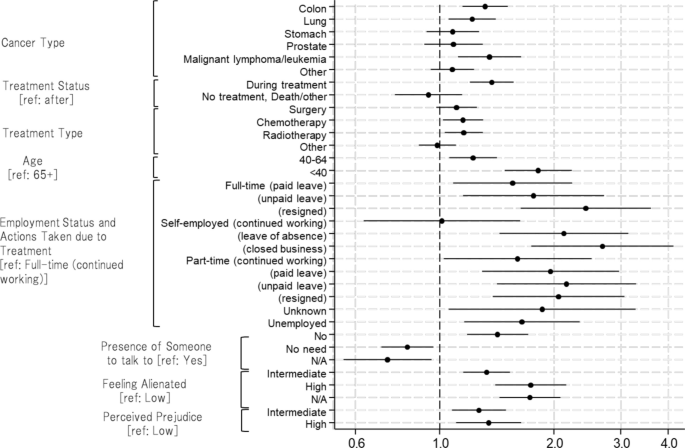
Point estimates and 95% CIs for prevalence ratios of financial toxicity (FT) in males. A multivariate analysis using a modified Poisson regression model was conducted to assess the association between the outcome “Have FT” and explanatory variables. The plot highlights that specific cancer types, treatment types, employment status, and patients’ relationships with others are associated with FT. ref, reference; N/A, not applicable (questions restricted to patients themselves were marked as “N/A” if answered by a non-patient, such as a family member)
Among females, the PR for FT was higher in cervix/uterine and ovarian cancer, malignant lymphoma/leukemia, during treatment, chemotherapy, radiotherapy, younger individuals, those on unpaid leave or resigning due to treatment, those with no-one to talk to, those feeling alienated, and those with perceived prejudice from others (Fig. 3). Common factors associated with high PR across all “have FT” categories included being under age 39 and absence of someone to talk to (Online Resource Table S4).

Point estimates and 95% CIs for prevalence ratios of financial toxicity (FT) in females. A multivariate analysis using a modified Poisson regression model was conducted to assess the association between the outcome “Have FT” and explanatory variables. The plot highlights that specific cancer types, treatment types, and patients’ relationships with others are associated with FT. It also shows that the 95% CIs for employment status are wider for females than for males. ref, reference; N/A, not applicable (questions restricted to patients themselves were marked as “N/A” if answered by a non-patient, such as a family member
Discussion
FT, as defined in this study, affects approximately 30% of both sexes and was strongly associated with demographic and psychosocial factors. Younger patients, those diagnosed with cancer frequently observed in younger populations, and individuals actively undergoing treatment were more likely to experience FT. Employment instability also heightened the risk. Interpersonal factors, including absence of someone to talk to and feelings of alienation, emerged as contributors. Among both sexes, being under age 39 and lacking interpersonal support showed high PRs across all categories of FT.
First, FT prevalence was found to be higher among the patient groups aged 39 or younger and those aged 40–64, than 65 or older. This aligns with prior research indicating that FT risk is more pronounced below retirement age (60–70 years) and in younger demographics [10, 12, 13]. Individuals diagnosed with cancer aged 15 to 39 are classified as Adolescent and Young Adult (AYA) patients and are recognized as a high-risk population for FT due to insufficient insurance coverage, resulting in high copays and potential long-term employment challenges [26]. This population tends to have lower income and assets than other age groups, coupled with higher expenses related to housing, education, childcare, and other future financial obligations. Fertility preservation associated with cancer treatment presents another medical cost burden for this population [26] and although fertility preservation therapies are covered by public health insurance in Japan, patients must still contribute to copays. AYA patients face elevated out-of-pocket medical costs and often have access to fewer public financial assistance programs than children and older adults [19]. In addition to financial concerns, this patient group presents unique medical needs that require specialized consideration [27,28,29]. They also exhibit lower treatment adherence rates than other age groups [29], suggesting that FT may contribute to poor adherence in the under 39 population of our study.
Second, consistent with previous studies [14, 30], both sexes exhibited a higher PR of FT during treatment, probably leading to coping behaviors such as cutting back on expenses, even essential living expenses or treatment costs to manage both current and potential expenditure.
Third, the cancer types noted above, which showed high FT risk in this study, also have relatively high incidence rates among the AYA population, necessitating further attention to FT in these cases [31]. As we had inconsistent information regarding cancer stage, we were unable to examine the association between stage and FT in this study.
Regarding psychosocial factors, employment status at diagnosis was strongly associated with FT. Part-time employment showed higher PRs for treatment-receiving behavior in both sexes, while self-employment was notably linked among men (Online Source Table S3). These respondents may have had more concerns about income insecurity and continued employment than those in full-time employment. The results were not consistent regarding changes in taking leave or resigning; since the reference was “continued working,” we assume that the high PR applied even for paid leave of absence. Although cancer patients suffer from long-term effects on employment and income, barriers to retaining employment remain underdiscussed [32]. The complexity of these issues is compounded by the fact that they extend beyond the support provided by healthcare services, being influenced by employers as well as labor laws and regulations.
Another critical point is the higher PR across all FT categories among both sexes who had no-one to talk to about their illness and daily life issues from diagnosis to the start of treatment. This could reflect limited interpersonal relationships predating diagnosis, which may reduce available social support, lower individuals’ ability to seek help, thus creating an unsupportive environment. These pathways can limit access to information and practical assistance (e.g., benefit applications, financial aid), increase emotional distress, and impair effective cost management and shared decision‑making, thereby increasing the risk of FT. Support-seeking behaviors are vital assessment domains of FT in addition to coping behaviors [33]. Littman et al. suggested that structured cost conversations between oncologists and patients could help identify financial toxicity and enable early interventions, emphasizing the importance of shared decision-making in cancer care. However, although more than 90% of patients expressed a desire to discuss costs, fewer than 15% reported actually having such conversations, in contrast to the oncologists’ self-reported rate of approximately 60% [34]. A study of FT among breast cancer patients in Japan similarly suggested that insufficient information from physicians and inadequate family support were associated with increased FT [13]. Research from other countries has also shown that both formal and informal support are crucial for treatment continuation. Patient navigators effectively support continuation by providing emotional and social support, including financial assistance, and connection with resources and support systems [35]. One qualitative study highlighted patients’ needs for financial counseling and navigation throughout diagnosis and treatment [36], while a study on financial distress in breast cancer survivors indicated that low social support during treatment may heighten financial distress post-treatment [37]. Difficulty in seeking such social support—emotional, informational, or financial—might partly explain the observed association. Social support-seeking behavior may differ across cultures; for example, one study reported that while Japanese individuals tend to feel shame and guilt at receiving support, some Western populations are more likely to feel pride when helped [38]. This cultural tendency could make Japanese patients less likely to seek social support; however, applying these findings to the present study is speculative. We therefore present this as a possible hypothesis rather than a definitive explanation.
The correlation between feelings of alienation since diagnosis, prejudice related to cancer and FT in the study population suggests a link between treatment-related financial hardship and interpersonal relationships. This aligns with previous studies that have reported that patients experiencing a significant financial burden expressed lower satisfaction with their relationships and a three-fold increased risk of depression [39, 40]. However, because our data are cross-sectional, the directionality of these associations cannot be determined, and the results should be interpreted with caution.
The study has several limitations. Firstly, key potential confounders were absent: socioeconomic indicators such as detailed household income and wealth, or household composition or spousal/dependent status, were not available in our dataset. Their omission may have led to residual confounding. In the context of Japan, where men are often the primary household earners, this lack of data may have introduced bias into FT prevalence estimations, especially in subgroup analyses of women. We included employment status as a partial proxy for socioeconomic position, but this variable is an imperfect substitute for income or wealth and cannot fully account for socioeconomic heterogeneity. Specifically, among part-time workers, we could not distinguish between those who are independent earners and those who are financially supported by a spouse. Consequently, the higher FT risk among the economically independent may be diluted by the lower risk among the dependent, leading to underestimation of FT prevalence in this group. Additionally, lack of insurance and copayment data may have biased our results. Although Japan has income-based caps on out-of-pocket spending and copayment structures differ by age group [19], we could not account for private insurance or other aspects of coverage. Available covariates such as age and employment status cannot capture an individual’s actual financial protection against healthcare costs. The study also lacked clinical information. Advanced cancer stage and greater disease severity are likely associated with higher FT; however, patients with advanced disease may have been less likely to participate in the survey. Therefore, omitting stage and severity from our analyses could have led to underestimation of overall FT prevalence. In addition, we did not have data on detailed treatment costs—and thus could not distinguish patients facing high medication or procedural expenses from those with lower direct costs, possibly further contributing to underestimation of FT in the study population. Further, because we operationalized FT using proxy coping-behavior items rather than validated tools, we cannot exclude the possibility of misclassification bias. Although we categorized FT into three levels based on the potential impact on treatment and daily life, individual items such as “used long‑term savings” and “received financial assistance or loans from others” do not necessarily indicate equivalent severity. Treating these qualitatively different behaviors as comparable may lead to misclassification and could either overestimate or underestimate FT, depending on item prevalence and co-occurrence. Given the cross-sectional nature of the study, establishing a causal relationship between FT and the identified factors is challenging. Although some psychosocial variables are temporally prior to the FT measures—making reverse causation (e.g., FT causing loss of social support) less likely for these exposures—causal inference remains limited. Longitudinal studies are needed to clarify temporal relationships and causal mechanisms. Lastly, this study was exploratory and included multiple explanatory variables in a single model to identify factors strongly associated with FT; therefore, we cannot exclude the possibility of false-positive findings due to multiplicity, and results should be interpreted with caution. Nevertheless, it is noteworthy that established risk factors such as young age at cancer diagnosis, during treatment, and resignation from employment due to treatment were consistent with findings from previous research. Thus, despite these limitations, the study findings contribute to the understanding of FT among cancer patients. A further strength is the composition of the study sample, which included adult cancer patients from across the nation. This representation enabled the identification of key patient characteristics associated with high FT within the framework of Japan’s UHC system. Since the risk of FT increases among the working population and during treatment, the planned increase in the upper limit of Japan’s High Cost Medical Expense Benefit System, effective from 2025, will have a major impact on patients’ treatment decisions. Based on these findings, even under the UHC system, it is imperative to provide support and consultation to mitigate the economic impact of cancer treatment, as well as to establish a work environment that prevents patients from having to resign or take long-term unpaid leave, regardless of their employment type or working conditions.
Conclusion
This study highlights the burden of FT among adult cancer patients in Japan, particularly among younger patients, those undergoing treatment, individuals with unstable employment, and limited interpersonal support. Mitigating FT requires targeted interventions, including improved consultation services in healthcare and communities, and workplace initiatives to balance treatment and employment. Additionally, these findings offer critical evidence for policy discussions on the planned reforms to the High-Cost Medical Expense Benefit System, which risks increasing the burden on working-age individuals and patients undergoing treatment—groups identified as being at high risk of FT. Advocacy efforts are essential to foster greater understanding and support for cancer patients and survivors.
Data availability
The data that support the findings of this study are available from the National Cancer Center Japan. Restrictions apply to the availability of these data, which were used under license for this study. Data are available from the authors with the permission of the National Cancer Center Japan.
References
Bray F, Laversanne M, Sung H et al (2024) Global cancer statistics 2022: GLOBOCAN estimates of incidence and mortality worldwide for 36 cancers in 185 countries. CA Cancer J Clin 74(3):229–263. https://doi.org/10.3322/caac.21834
Ugai T, Sasamoto N, Lee HY et al (2022) Is early-onset cancer an emerging global epidemic? Current evidence and future implications. Nat Rev Clin Oncol 19(10):656–673. https://doi.org/10.1038/s41571-022-00672-8
Japanese Foundation for Cancer Research. Cancer statistics in Japan 2018. p 9. https://www.fpcr.or.jp/pdf/p21/cancer_statistics_2018.pdf. Accessed 14 May 2025
National Cancer Institute. Financial toxicity (financial distress) and cancer treatment (PDQ®)–Health professional version. National Cancer Institute. https://www.cancer.gov/about-cancer/managing-care/track-care-costs/financial-toxicity-hp-pdq. Accessed 14 May 2026
Chino F, Nipp R (2025) Financial toxicity in cancer care: where are we, and how did we get here? Introduction to a special series. JCO Oncol Pract 21(1):1–3. https://doi.org/10.1200/op-24-00793
Zafar SY, Abernethy AP (2013) Financial toxicity, Part I: A new name for a growing problem. Oncology (Williston Park) 27(2):80–149
Pisu M, Martin MY (2022) Financial toxicity: A common problem affecting patient care and health. Nat Rev Dis Primers 8(1):7. https://doi.org/10.1038/s41572-022-00341-1
Bernard DS, Farr SL, Fang Z (2011) National estimates of out-of-pocket health care expenditure burdens among nonelderly adults with cancer: 2001 to 2008. J Clin Oncol 29(20):2821–2826. https://doi.org/10.1200/jco.2010.33.0522
Ramsey S, Blough D, Kirchhoff A et al (2013) Washington State cancer patients found to be at greater risk for bankruptcy than people without a cancer diagnosis. Health Aff (Millwood) 32(6):1143–1152. https://doi.org/10.1377/hlthaff.2012.1263
Longo CJ, Fitch MI, Banfield L, Hanly P, Yabroff KR, Sharp L (2020) Financial toxicity associated with a cancer diagnosis in publicly funded healthcare countries: a systematic review. Support Care Cancer 28(10):4645–4665. https://doi.org/10.1007/s00520-020-05620-9
Bhoo-Pathy N, Ng CW, Lim GC et al (2019) Financial toxicity after cancer in a setting with universal health coverage: a call for urgent action. J Oncol Pract 15(6):e537–e546. https://doi.org/10.1200/jop.18.00619
Honda K, Gyawali B, Ando M et al (2019) Prospective survey of financial toxicity measured by the comprehensive score for financial toxicity in Japanese patients with cancer. J Glob Oncol 5:1–8. https://doi.org/10.1200/jgo.19.00003
Saeki S, Iwatani T, Kitano A et al (2023) Factors associated with financial toxicity in patients with breast cancer in Japan: a comparison of patient and physician perspectives. Breast Cancer 30(5):820–830. https://doi.org/10.1007/s12282-023-01476-z
Gyawali B, Chen N, Tu D, Pater J (2025) Financial difficulty among patients with cancer participating in clinical trials and its association with patient survival and quality of life. J Natl Cancer Inst. https://doi.org/10.1093/jnci/djaf221
Kajimoto Y, Honda K, Suzuki S et al (2023) Association between financial toxicity and health-related quality of life of patients with gynecologic cancer. Int J Clin Oncol 28(3):454–467. https://doi.org/10.1007/s10147-023-02294-1
Perrone F, Jommi C, Di Maio M et al (2016) The association of financial difficulties with clinical outcomes in cancer patients: secondary analysis of 16 academic prospective clinical trials conducted in Italy. Ann Oncol 27(12):2224–2229. https://doi.org/10.1093/annonc/mdw433
National Cancer Center Institute for Cancer Control. Cancer Policy evaluation project 2014. Patient Experience Survey 2014. National Cancer Center, Japan; 2015. (in Japanese). https://pod.ncc.go.jp/jp/icc/policy-evaluation/project/010/2014/H27pes_chap7.pdf. Accessed 14 May 2026
National Cancer Center Institute for Cancer Control. Cancer Policy evaluation project 2014. Patient Experience Survey 2018. National Cancer Center, Japan; 2020. (in Japanese) https://pod.ncc.go.jp/jp/icc/policy-evaluation/project/010/2018/H30_all.pdf. Accessed 14 May 2026
Ministry of Health, Labour and Welfare, Japan. Health insurance policy in Japan. Ministry of Health, Labour and Welfare. (in Japanese). https://www.mhlw.go.jp/stf/seisakunitsuite/bunya/kenkou_iryou/iryouhoken/iryouhoken01/index.html. Accessed 14 May 2026
Tokyo Metropolitan Government Bureau of Social Welfare and Public Health. Tokyo welfare 2023. Published 2023. https://www.fukushi.metro.tokyo.lg.jp/documents/d/fukushi/2023_english_5. Accessed 14 May 2026
Ministry of Health, Labour and Welfare, Japan. Revision of the high-cost medical expense benefit system. Ministry of Health, Labour and Welfare; 2025. (in Japanese), https://www.mhlw.go.jp/content/12401000/001393881.pdf. Accessed May 14, 2026
Watanabe T, Ichinose Y, Matsuki M et al (2021) Experiences of patients with cancer at health care facilities in Japan: Results from a nationwide survey. BMC Health Serv Res 21(1):1180. https://doi.org/10.1186/s12913-021-07184-8
Zafar SY, Peppercorn JM, Schrag D et al (2013) The financial toxicity of cancer treatment: a pilot study assessing out-of-pocket expenses and the insured cancer patient’s experience. Oncologist 18(4):381–390. https://doi.org/10.1634/theoncologist.2012-0279
Hlubocky FJ, Cella D, Daugherty CK (2025) Financial toxicity has never been more important in cancer care: how do we measure it? JCO Oncol Pract 21(1):52–56. https://doi.org/10.1200/op.24.00162
Ministry of Health, Labour and Welfare, Japan. Cancer Control promotion plan: initiatives to promote cancer control (summary). Ministry of Health, Labour and Welfare. p20 (in Japanese). https://www.mhlw.go.jp/content/10900000/001138889.pdf. Accessed 14 May 2026
Ragavan MV, Mora RV, Nipp R, Winestone LE (2025) Band-aids can still help heal: the role of patient financial assistance programs in addressing financial toxicity. JCO Oncol Pract 21(1):73–77. https://doi.org/10.1200/op.24.00287
Salsman JM, Bingen K, Barr RD, Freyer DR (2019) Understanding, measuring, and addressing the financial impact of cancer on adolescents and young adults. Pediatr Blood Cancer 66(7):e27660. https://doi.org/10.1002/pbc.27660
Trama A, Stark D, Bozovic-Spasojevic I et al (2023) Cancer burden in adolescents and young adults in Europe. ESMO Open 8(1):100744. https://doi.org/10.1016/j.esmoop.2022.100744
Hughes N, Stark D (2018) The management of adolescents and young adults with cancer. Cancer Treat Rev 67:45–53. https://doi.org/10.1016/j.ctrv.2018.05.001
Kale HP, Carroll NV (2016) Self-reported financial burden of cancer care and its effect on physical and mental health-related quality of life among US cancer survivors. Cancer 122(8):283–289. https://doi.org/10.1002/cncr.29808
Nakata K, Matsuda T, Hori M et al (2023) Cancer incidence and type of treatment hospital among children, adolescents, and young adults in Japan, 2016-2018. Cancer Sci 114(9):3770–3782
Anant S, Jiang C, Doran J et al (2025) Social and legal needs in patients and families with cancer: interaction with patient-level financial toxicity. JCO Oncol Pract 21(1):41–51. https://doi.org/10.1200/OP.24.00305
Dar MA, Chauhan R, Murti K, Trivedi V, Dhingra S (2022) Development and validation of Subjective Financial Distress Questionnaire (SFDQ): A patient reported outcome measure for assessment of financial toxicity among radiation oncology patients. Front Oncol 11:819313. https://doi.org/10.3389/fonc.2021.819313
Littman D, Lam AB, Chino F (2025) Cost conversations to mitigate the effects of financial toxicity in oncology: current state, opportunities, and barriers. JCO Oncol Pract 21(1):23–28. https://doi.org/10.1200/op-24-00454
Ferrante JM, Chen PH, Kim S (2008) The effect of patient navigation on time to diagnosis, anxiety, and satisfaction in urban minority women with abnormal mammograms: a randomized controlled trial. J Urban Health 85(1):114–124. https://doi.org/10.1007/s11524-007-9228-9
Dean LT, Moss SL, Rollinson SI, Frasso Jaramillo L, Paxton RJ, Owczarzak JT (2019) Patient recommendations for reducing long-lasting economic burden after breast cancer. Cancer 125(11):1929–1940. https://doi.org/10.1002/cncr.32012
Semin JN, Palm D, Smith LM, Ruttle S (2020) Understanding breast cancer survivors’ financial burden and distress after financial assistance. Support Care Cancer 28(9):4241–4248. https://doi.org/10.1007/s00520-019-05271-5
Ishii K, Mojaverian T, Masuno K, Kim HS (2017) Cultural differences in motivation for seeking social support and the emotional consequences of receiving support: the role of influence and adjustment goals. J Cross Cult Psychol 48(9):1442–1456. https://doi.org/10.1177/0022022117731091
Fenn KM, Evans SB, McCorkle R et al (2014) Impact of financial burden of cancer on survivors’ quality of life. J Oncol Pract 10(5):332–338. https://doi.org/10.1200/jop.2013.001322
Sharp L, Carsin AE, Timmons A (2013) Associations between cancer-related financial stress and strain and psychological well-being among individuals living with cancer. Psychooncology 22(4):745–755. https://doi.org/10.1002/pon.3055
Acknowledgements
The authors would like to express our gratitude to the medical institutions that participated in this survey and to the patients and their families who kindly took the time to respond. We also appreciate Dr. Julia Mortimer for reviewing the English language of this manuscript, and Dr. Tomone Watanabe (Division of Health Services Research, Center for Cancer Control and Information Services, National Cancer Center) for her valuable contributions to the survey.
Funding
Open Access funding provided by Kobe University This work was supported by the Grant-in-Aid for Scientific Research B (KAKENHI) from the Japan Society for the Promotion of Science (grant numbers 23K21510 and 21H03174) and the Sciences Research Grants from the Ministry of Health, Labour and Welfare of Japan (grant numbers 20EA1019 and 23EA1007).
Author information
Authors and Affiliations
Contributions
K.S. designed the study, conducted the literature search, performed data analysis, interpreted the results, and wrote and revised the manuscript. Y.I. (corresponding author) provided primary supervision to K.S., assisted with data analysis and data management, and contributed to manuscript revision. K.I. and N.K., as supervisors of K.S.'s master's thesis, contributed to the study design, interpretation of results, and provided guidance for manuscript preparation. Y.I. and T.H. were responsible for the collection, design, and management of the data used in this study.
Corresponding author
Ethics declarations
Ethics approval
All procedures performed in studies involving human participants were conducted in accordance with the ethical standards of the Institutional Review Board at Osaka Medical and Pharmaceutical University and co-authors’ institutions (approval number 2023-102-1, October 31, 2023) and adhered to the principles of the 1964 Declaration of Helsinki and its later amendments.
Consent to participate and publish
Informed consent to participate in the study was obtained from each patient via questionnaire prior to its completion. For publication purposes, patients were also informed that their anonymous data would be used for research dissemination, and their consent was received accordingly.
Competing interests
The authors declare no competing interests.
Additional information
Publisher's Note
Springer Nature remains neutral with regard to jurisdictional claims in published maps and institutional affiliations.
Supplementary information
Below is the link to the electronic supplementary material.
ESM 1 (download PDF )
(PDF 167 KB)
ESM 2 (download PDF )
(PDF 247 KB)
Rights and permissions
Open Access This article is licensed under a Creative Commons Attribution-NonCommercial-NoDerivatives 4.0 International License, which permits any non-commercial use, sharing, distribution and reproduction in any medium or format, as long as you give appropriate credit to the original author(s) and the source, provide a link to the Creative Commons licence, and indicate if you modified the licensed material. You do not have permission under this licence to share adapted material derived from this article or parts of it. The images or other third party material in this article are included in the article's Creative Commons licence, unless indicated otherwise in a credit line to the material. If material is not included in the article's Creative Commons licence and your intended use is not permitted by statutory regulation or exceeds the permitted use, you will need to obtain permission directly from the copyright holder. To view a copy of this licence, visit http://creativecommons.org/licenses/by-nc-nd/4.0/.
About this article

Cite this article
Suga, K., Ito, Y., Inoue, K. et al. Sociodemographic Factors related to Financial Toxicity among Cancer Patients and Survivors:“The Second Cancer Patient Experience Survey” — A Nationwide Study in Japan. Support Care Cancer 34, 614 (2026). https://doi.org/10.1007/s00520-026-10818-4
Received:
Accepted:
Published:
Version of record:
DOI: https://doi.org/10.1007/s00520-026-10818-4